Life of Christ
Lecture Notes-----
Topic 3.2.5
for Religion 102 / 305
Topics 3.1 -
3.6 for Religion 311
Last revised: 4/7/05
Explanation:
Contained below is a manuscript
summarizing the class lecture(s) covering the above specified range of
topics from the List of Topics for your class. For updated information
about the class see the Bulletin Board. Quite often hyperlinks (underlined)
to sources of information etc. will be inserted in the text of the lecture.
These should be consulted as possible sources for answering either the
Objective Questions (Exam
1 option) or the Take-Home Questions (Exam
3 option) in Religion 101/305. Test questions for all
three exam options will be derived in part from these lectures. To
display the Greek text contained in this page download and install the
free BSTGreek from Bible Study Tools.  |
When one begins to take seriously
the story of Jesus in each of the four canonical gospels, a pattern emerges
in the way this story is told. The pattern is much tighter in the Synoptic
Gospels in that they use a common overarching structure for telling their
story of Jesus. The fourth gospel has its own way of telling the story,
but can be correlated to the synoptic gospel framework in a supplementary
manner.
What follows below is an
investigation into that structure. The outline for this is the Life
of Christ. This includes six major segments in the story:
3.2.5.1. Background and Preparation
for Ministry
3.2.5.2. Beginning of Public Ministry
3.2.5.3. The Galilean Ministry
3.2.5.4. The Later Judean-Perean Ministry
3.2.5.5. The Final Week and Crucifixion (Passio
Christi)
3.2.5.6. Resurrection and Appearances
3.2.5.1. Background
and Preparation for Ministry
1:1-2:23
(4%)2 |
--------- |
1:1-2:52
(11%) |
1:1-18
(2%) |
As reflected in the above
list, this segment in the story of Jesus is missing in the Gospel of
Mark. For his own purposes, Mark jumps directly into the public ministry
of Jesus rather than prepare his readers by providing some details of who
Jesus was either from his historical origins (as in Matthew and Luke) or
from his spiritual nature (as in John).
1:1-2:23
(4%)2 |
---- |
1:1-2:52
(11%) |
1:1-18
(2%) |
1.
Genealogy:
Abraham to David 1:2-6
2. Genealogy:
David to Joseph 1:7-16
3. Genealogy:
Summary Comment 1:17
4. Angelical announcement to Joseph 1:18-23
5. Joseph's obedience 1:24-25
6. Visit by wise men. 2:1-12
7. Flight to Egypt 2:13-15
8. Slaying of children in Bethlehem 2:6-18
9. Return from Egypt 2:19-23 |
|
1.
Prologue
1:1-4
2. Announcement of John's birth
1:5-25
3. Announcement of Jesus' birth
1:26-38
4. Mary's visit to Elizabeth 1:39-56
5. John's birth 1:57-80
6. Jesus' birth 2:1-21
7. Jesus' presentation in the temple
2:22-40
8.
Jesus' visit to the temple 2:41-52 |
|
In the two synoptic
gospels, the background of Jesus is presented in a more historical oriented
narrative typically designated the Infancy
Narratives by modern scholars. Some general observations are in order:
(1)
From the per centages listed above, Luke (11%) devotes more space to this
segment than does Matthew (4%). This is reflected in the specific
episodes included in each account.
Although Matthew contains
nine episodes to Luke's eight episodes, Luke provides greater detail in
each of these pericopes about the birth and early childhood of Jesus. Additionally,
Luke begins with a formal prologue to his gospel
account that followed ancient patterns of prologue composition. Important
to remember: both gospels deal only with the first three or four years
of Jesus' childhood, with the one exception of the Lucan account of Jesus'
bar mitzvah at the beginning of puberty around his twelfth birthday. In
ancient Jewish tradition a male did not become an adult until his thirtieth
birthday, which Luke marks as the beginning of Jesus' public ministry (Lk.
3:23). The canonical gospels are silent about the time from around three
years until his thirtieth year with the one Lucan exception (see
#8 in above list). Luke simply summarizes all these years with the
short statement in 2:52: "And Jesus increased in wisdom and in years, and
in divine and human favor" (NRSV).
Outside the canonical gospels,
however, the NT Apocryphal Gospels
attempt to 'fill in the void' with numerous episodes supposedly depicting
events in the childhood of Jesus. Mostly they focus on Jesus' early childhood
in the same time period of Matthew and Luke. Among these so-called infancy
gospels are the Infancy
Gospel of James, the Infancy
Gospel of Thomas, the Infancy
Gospel of Pseudo-Matthew, and the Birth
of Mary. They paint a dramatically different picture. Jesus' childhood
was no ordinary, normal experience as depicted in Matthew and Luke. To
the contrary, the deity aspect overwhelmed Jesus' consciousness even as
an infant and dictated his pattern of behavior. As an infant he could think
and talk like an adult and had complete awareness of being perfectly divine
and possessed full supernatural powers as a child. He performed miracles
as a three year old; as a small youngster he offered sage advice to adults,
especially religious authorities, that put their ignorance of divine matters
to shame; he basically told his parents what to do rather than the other
way around. With the contemporary model of the Greco-Roman Theos Aner (God-Man)
emphasizing that significant persons had this kind of childhood, later
Christians in the second through fifth centuries, with no Jewish roots
and a deep anti-semitic bias against things Jewish, reinterpreted Jesus
with non-Jewish, Greco-Roman cultural contours to make him more appealing
to the people of their day. Never mind that their stories were complete
fabrications with no basis in history at all! One can easily see why mainstream
Christianity in this era quickly and thoroughly rejected this 'gospels'
as worthless accounts about the Jesus of history.
(2)
Each synoptic gospel writer has his own distinct account of this period.
No overlapping of episodes occurs between the two accounts.
The closest thing to an
overlap in Matthew (see pericopes 1 and 2 above) and
Luke (see pericope 15 below) is the genealology
listing. Yet, even here each gospel writer is very distinctive in the
presentation of the family tree of Jesus. Matthew traces Jesus' ancestory
back to Abraham, while Luke goes back to Adam. Matthew traces the ancestory
through Mary, while Luke traces it through Joseph. Matthew traces the lineage
forward to Christ, while Luke traces it backward to Adam. Unlike Matthew,
Luke places the geneaology at the beginning of Jesus' public ministry section.
Once Matthew has introduced
Jesus through his ancestoral lineage, he turns to a selected number of
events highlighting the coming of God's Annointed Deliverer. These include:
4.
Angelical announcement to Joseph 1:18-23
5. Joseph's obedience 1:24-25
6. Visit by wise men. 2:1-12
7. Flight to Egypt 2:13-15
8. Slaying of children in Bethlehem 2:6-18
9. Return from Egypt 2:19-23
These events cover the announcement of Jesus' birth with the positive
image of Joseph stressed in pericopes 4 and 5. Interestingly, almost no
description of Jesus' birth is contained. Only two brief allusions are
found in Matthew: (1) "Now the birth of Jesus the Messiah took place in
this way" (1:18); and (2) "he took her as his wife, but had no marital
relations with her until she had borne a son; and he named him Jesus" (1:24b-25).
These parentheses to the Joseph narratives merely allude to the birth of
Jesus. The next mention of Jesus in pericope 6 is to an event happening
subsequent to Jesus' birth - the visit of the magi from the area of ancient
Babylon where Jews had lived since the exile in the sixth century B.C.E.
The hostile response of Herod the Great to their visit prompts the fleeing
to Egypt by Joseph in order to save the life of the young Jesus. No mention
is made as to where in Egypt they lived, nor of how they lived while there.
After Herod's death in 4 B.C.E., Joseph
brings his family out of Egypt and resettles at the village of Nazareth
in southwest Galilee where Mary had grown up. Containing never more than
two hundred residents, the small village was settled after the Babylonian
exile and was located not far from the old capital city of Sepphoris
and also was near one of the major north-south trade routes from Damascus
to Egypt (see map). Jesus lived out
his childhood and youth there until the beginning of his ministry at reaching
adulthood on his thirtieth birthday. But Matthew makes no mention of anything
that happened during these years.
After Luke introduces his
gospel with a formal prologue in the pattern
of many such instances of this genre in ancient literature, he begins his
story of the birth and childhood of Jesus. But he concentrates on entirely
different events than those found in Matthew.
2.
Announcement of John's birth
1:5-25
3.
Announcement of Jesus' birth
1:26-38
4.
Mary's visit to Elizabeth 1:39-56
5.
John's birth 1:57-80
6.
Jesus' birth 2:1-21
7.
Jesus' presentation in the temple
2:22-40
8.
Jesus' visit to the temple 2:41-52
The role of John the Baptizer is highlighted first
in pericope 2 with the unusual announcement of his birth to Elizabeth's
husband Zechariah, while he was serving one of his rotations as a peasant
priest in the temple in Jerusalem. Then follows an announcement to a teenager
named Mary living in Nazareth that she is going to give birth to Jesus
(pericope 3). This is followed by a visit of Mary to Elizabeth, a
relative, who lived in the hill country, several miles to the south in
the province of Judea. No mention is made of Mary's parents and any circumstances
of how she traveled from Nazareth to Judea, other than that Elizabeth was
well into her pregnancy (1:44). Elizabeth responded with a song of blessing
to Mary (1:42-45). Most of pericope 4 is devoted to Mary's song of praise
to God for these blessings (1:46-55). After a three month stay with Elizabeth,
Mary returned to her parents home in Nazareth (1:56).
In
a parallel fashion to the announcements, the birth accounts of first John
and then Jesus follow in pericopes 5 and 6. Most of pericope 5 is devoted
to Zechariah's prophecy about God fulfilling his messianic promise to send
a deliverer to his people (1:67-79). A simple statement concludes, summarizing
John's childhood and youth (1:80): "The child grew and became strong in
spirit, and he was in the wilderness until the day he appeared publicly
to Israel." The birth of Jesus is divided into two sections with
an explanation of the trip from Nazareth in Galilee to Bethlehem in Judea
where Jesus was born (2:1-7), and then the visit of the temple shepherds
to see the new born infant (2:8-20). The Torah mandated circumcision of
Jesus at eight days of age, which included the offical naming of the infant,
concludes this narrative (2:21). Unlike Matthew who makes no reference
to the growing up years of Jesus, Luke includes one incident, the visit
to the temple at age twelve amounting to the ancient bar mitzvah for Jewish
boys reaching puberty (pericope 7). This is followed by the narrative of
Jesus as a twelve year old boy surpising the Jewish temple authorities
with his exception understanding of the Torah (pericope 8). This is conclued
by a summary statement about Jesus, similar to the earlier one about John,
in 2:52: "And Jesus increased in wisdom and in years, and in divine and
human favor."
Each
gospel writer chooses only a small number of events to include in their
infancy narratives. But each event is selected according to the individual
gospel writer's purpose for his story of Jesus. Matthew highlights the
Jewish side of Jesus' beginnings with prophetic fulfillment and symbolic
exodus from Egypt. Luke, on the other hand, stresses the inclusiveness
of Jesus' beginnings, along with the very unusual aspects of Jesus' birth,
in a pattern reminiscent of the Greco-Roman Bios, the biography of famous
individuals.
(3)
Both synoptic gospel accounts treat only the birth and early childhood
of Jesus through his first twelve years. This
is quite different from modern biographical concerns that demand a full
accounting of all the years of the person being described. To modern westerners
accustomed to biography patterns, the absence of any mention of the life
of Jesus from twelve years to thirty years seems strange. Yet, Matthew
and Luke did not deem it necessary to provide a detailed accounting of
the first thirty years of Jesus' life. For Mark, these years were not important
to his concerns in telling the story of Jesus, and thus no mention of them
is made at all. That is not to say that later Christian tradition wasn't
interested in these years. In the so-called Apocryphal
Infancy Gospels the focus of attention is mainly on these years as
legendary stories of fantastic accomplishments of the boy Jesus are set
forth in the pattern of the ancient Greco-Roman Theos-Aner (God-Man). The
Protevangelium of James, produced in the second century A.D. Syrian Christian
circles, focuses on the glorification of Mary as a perpetual virgin who
only gave birth to Jesus via supernatural means. The brothers and sisters
of Jesus are claimed as being from a previous marriage of Joseph before
he married Mary. The Infancy
Gospel of Thomas, also from the second century A.D., provides numerous
stories of spectacular feats of the boy Jesus. Below is an excerpt from
the Arabic
Infancy Gospel, providing a sampling of this type of legendary material:
37.
On a certain day the Lord Jesus, running about and playing with the boys,
passed the shop of a dyer, whose name was Salem; and he had in his shop
many pieces of cloth which he was to dye. The Lord Jesus then, going into
his shop, took up all the pieces of cloth, and threw them into a tub full
of indigo. And when Salem came and saw his cloths destroyed, he began to
cry out with a loud voice, and to reproach Jesus, saying: Why hast thou
done this to me, O son of Mary? Thou hast disgraced me before all my townsmen:
for, seeing that every one wished the colour that suited himself, thou
indeed hast come and destroyed them all. The Lord Jesus answered: I shall
change for thee the colour of any piece of cloth which thou shalt wish
to be changed. And immediately He began to take the pieces of cloth out
of the tub, each of them of that colour which the dyer wished, until He
had taken them all out. When the Jews saw this miracle and prodigy, they
praised God.
38.
And Joseph used to go about through the whole city, and take the Lord Jesus
with him, when people sent for him in the way of his trade to make for
them doors, and milk-pails, and beds, and chests; and the Lord Jesus was
with him wherever he went. As often, therefore, as Joseph had to make anything
a cubit or a span longer or shorter, wider or narrower, the Lord Jesus
stretched His hand towards it; and as soon as He did so, it became such
as Joseph wished. Nor was it necessary for him to make anything with his
own hand, for Joseph was not very skilful in carpentry.
39.
Now, on a certain day, the king of Jerusalem sent for him, and said: I
wish thee, Joseph, to make for me a throne to fit that place in which I
usually sit. Joseph obeyed, and began the work immediately, and remained
in the palace two years, until he finished the work of that throne. And
when he had it carried to its place, he perceived that each side wanted
two spans of the prescribed measure. And the king, seeing this, was angry
with Joseph; and Joseph, being in great fear of the king, spent the night
without supper, nor did he taste anything at all. Then, being asked by
the Lord Jesus why he was afraid, Joseph said: Because I have spoiled all
the work that I have been two years at. And the Lord Jesus said to him:
Fear not, and do not lose heart; but do thou take hold of one side of the
throne; I shall take the other; and we shall put that to rights. And Joseph,
having done as the Lord Jesus had said and each having drawn by his own
side, the throne was put to rights, and brought to the exact measure of
the place. And those that stood by and saw this miracle were struck with
astonishment, and praised God. And the woods used in that throne were of
those which are celebrated in the time of Solomon the son of David; that
is, woods of many and various kinds.
40.
On another day the Lord Jesus went out into the road, and saw the boys
that had come together to play, and followed them; but the boys hid themselves
from Him. The Lord Jesus, therefore, having come to the door of a certain
house, and seen some women standing there, asked them where the boys had
gone; and when they answered that there was no one there, He said again:
Who are these whom you see in the furnace?' They replied that they were
kids of three years old. And the Lord Jesus cried out, and said: Come out
hither, O kids, to your Shepherd. Then the boys, in the form of kids, came
out, and began to dance round Him; and the women, seeing this, were very
much astonished, and were seized with trembling, and speedily, supplicated
and adored the Lord Jesus, saying: O our Lord Jesus, son of Mary, Thou
art of a truth that good Shepherd of Israel; have mercy on Thy handmaidens
who stand before Thee, and who have never doubted: for Thou hast come,
O our Lord, to heal, and not to destroy. And when the Lord Jesus answered
that the sons of Israel were like the Ethiopians among the nations, the
women said: Thou, O Lord, knowest all things, nor is anything hid from
Thee; now, indeed, we beseech Thee, and ask Thee of Thy affection to restore
these boys Thy servants to their former condition. The Lord Jesus therefore
said: Come, boys, let us go and play. And immediately, while these women
were standing by, the kids were changed into boys.
Quite obviously these stories paint a very different picture of Jesus as
a boy than is found in the canonical gospels. Luke's summary statement,
(2:52) "And Jesus increased in wisdom and in years,
and in divine and human favor," strongly asserts that Jesus had a normal
childhood and youth. His consciousness of being the divine Son of God did
not come until the beginning of public ministry. Absolutely no indication
exists in the canonical sources that Jesus' performed miracles before the
beginning of public ministry as an adult. In fact, John 1:11 indicates
that the turning of the water into wine at Cana was the first miracle that
Jesus did. Therefore, the legendary nature along with the Gnostic theological
assumptions behind most all these documents renders them of little use
in learning historical information about Jesus as a child and a boy. But
they do serve as a strong warning against allowing contemporary culturally
driven models becoming the authoritative filter through which we understand
Jesus. Else, we remake Jesus into an image that suits our fancies, rather
than allowing the canonical texts to shape our understanding.
(4)
The literary sub-genre of this material is Infancy Narrative.
For an extensive bibliography on research done in this area, see my Annotated
Bibliography: 1.2.1 Infancy Narratives.
In
the ancient world the dramatic, extraordinary beginnings of important people
were considered to be an essential mark of a superior life that rose above
the ordinary. Without it, one would have had a difficult time being regarded
as anymore than 'run of the mill.' The pagan birth legends are a
part of the literary drive behind the infancy narratives in Matthew and
Luke, although the Jewish infancy narrative tradition also played an important
role, perhaps the more important model for the canonical gospel writers.
The birth of Moses (Exod. 2:1-10) stands as a beginning point here, and
was extended in the OT Apocryphal
and Pseudepigraphal materials.
To be sure, the non-canonical infancy gospels are driven in large part
by the pagan birth legend tradition in second and subsequent centuries
Greco-Roman cultural reinterpretation of apostolic Christianity.
In the fourth gospel, an
entirely different approach to introducing Jesus is taken. ThePrologue
to the fourth gospel sets forth foundational concepts about Jesus that
become the theological basis for telling the story of Jesus in the remainder
of the gospel account. The pericope is crafted in skillfully composed step
parallelism poetic structure at the informal level of through structure,
as is illustrated by the following diagram:
A 1-5
In the beginning was the Word,
and the Word was with God, and the Word was God. He was in the beginning
with God. All things came into being through him, and without him not one
thing came into being. What has come into being in him was life, and the
life was the light of all people. The light shines in the
darkness, and the darkness did not overcome it.
B 6-8
There was a man sent from God, whose name was John.
He came as a witness to testify to the light, so that all
might believe through him. He himself was not the light, but he came to
testify to the light.
C 9-13
The true light, which enlightens everyone, was coming into
the world. He was in the world, and the world came into being through him;
yet the world did not know him. He came to what was his own, and his own
people did not accept him. But to all who received
him, who believed in his name, he gave power to become children of God,
who were born, not of blood or of the will of the flesh or of the will
of man, but of God.
|
A’ 14
And the Word became flesh and
lived among us, and we have seen his glory, the glory as of a father’s
only son, full of grace and truth.
B’ 15John
testified to him and cried out, “This was he of whom I said, ‘He who comes
after me ranks ahead of me because he was before me.’”
C’ 16-18From
his fullness we have all received,
grace upon grace. The law indeed was given through Moses; grace
and truth came through Jesus Christ. No one has ever seen
God. It is God the only Son, who is close to the Father’s heart, who has
made him known.
|
Analysis of the Text:
ALogos
light
B
John/witness
C
received light |
A’ Logos
grace and truth
B'
John/witness
C'
received grace
and truth |
The central theme of both sections,
vv. 1-13, 14-18, is the Logos,
in as much as it serves as the header for each section. Thus the central
theme of the entire prologue is Logos.
Understanding the main point of the prologue then will depend upon an accurate
understanding of this key term. The boundary markers to the first section,
vv. 1-13, is the repetition of the word light. In
the second section, vv. 14-18, the repeated phrase grace
and truth serves the same role. The center strophe
to each section focuses upon the witness of John
the Baptist. The movement in each section
flows from the Logos through the witness of John to the response of receiving
the Logos through John's witness. The conceptual structure of the first
section, vv. 1-13 is universal: the Logos and all of creation including
humanity. The Logos manifests himself, is witnessed to by John, but only
a very small segment of humanity responds with acceptance. The step, advancement
of thought to a new level, occurs in section two, vv. 14-18, where the
Logos is received both Jew and Gentile in a fuller experience that brings
the 'receiver' face to face with Almighty God himself. The Logos reveals
himself to the world in vv. 1-5 and is largely rejected inspite of John's
witness. But in the section section, vv. 14-18, to those receiving the
Logos He reveals himself dramatically as the Shekina glory of God who tabernacled
with His people, v. 14 , and John's witness, v. 15, highlights that
superior revelation. The second receiving section, vv. 16-18, opens up
dramatically larger experiences of encounter. Each of the three strophes
of both sections contains an advancement of thought in the second section
parallel to that in the first section.
The
first section (vv. 1-13) develops the theme of the Logos in relation to
the created order of things. A climax is reached in the dominant rejection
of the Logos as redeeming Light in the C section, but in spite of this
some respond favorably and become the nucleus of a new community of faith
(1:12-13). This transitions into the section section (vv. 14-18), which
develops the theme of the Logos in relation to the believing community.
Here, where positive reception of the Logos prevails, "grace and truth"
become the dominant tones of this relationship. The divine glory/presence
reveals itself in the tabernacling of the Logos with his new people. John
has
a witness to this community; the consequence is that the community is overwhelmed
by the bestowal of divine grace and truth.
The
conceptual structure set forth here in the prologue becomes the interpretative
filter through which the story of Jesus is told in each of the subsequent
pericopes in the remainder of the fourth gospel. This is part of what gives
the fourth gospel its very distinctive character and tone. The Bible student
must first grasp this introductory 'theology of the Logos' if he/she is
to correctly exegete any subsequent pericope.
3.2.5.2. Beginning of Public Ministry
3:1-4:11
(3%) |
1:1-13
(2%) |
3:1-4:14
(5%) |
1:19-4:54
(16%) |
Once
again, the synoptic gospels differ significantly from the fourth gospel
in the way the public ministry of Jesus begins. In the synoptics, the focus
is on the role of John the Baptizer preparing the way for Jesus. This is
followed by the accounts of his temptation and baptism. Then public ministry
is launched in Galilee. The fourth gospel does focus on John (see pericopes
7 and 8 below), but launches into Jesus' public ministry without narratives
relating Jesus' temptation and baptism. Although Galilee is the geographical
location for a few of the episodes, Jerusalem plays an important role in
this beginning period as well, unlike the synoptic gospels that make no
mention of Jerusalem at this point in Jesus' ministry.
A. The public ministry of John the Baptist
John
stands out in the gospel accounts as a strange figure who pops on the scene
with a powerful message that distrubs and causes controversy.
B. The Beginning of Jesus' Public Ministry
The launching of public ministry
by Jesus is signaled in the syoptic gospels by two pivotal events: Jesus'
baptism and temptation. Mark's account condenses these two events into
a very brief narrative with few details. Matthew and Luke, both utilizing
their Marcan and Q sources, develop these two narrative into greater detail
while maintaning their individual perspectives. The Johannine gospel goes
a very different direction with a series of events narrated that do not
intersect the synoptic gospels at any point. These events take place both
in Judea and in Galilee, while the synoptic accounts focus on events taking
place only in Judea.
3.2.5.3. The Galilean Ministry
The formal public ministry
of Jesus, as recorded by the synoptic gospel writers, took place primarily
in the northern part of ancient Palestine, in the Roman province of Galilee.
Over half of the space devoted to the story of Jesus in both Matthew and
Mark narrates events taking place here. Luke devotes about one-fourth of
his gospel to this segment of Jesus' ministry, and the Johannine gospel
de-emphasizes the significance of Galilee considerably with only 15% of
its story given over to events taking place in Galilee.
How this period of ministry
unfolded can be debated from these sources, but two pivotal turning points
seem to signal shifts in the direction that Jesus' ministry took. The first
was the appointment of the twelve disciples as the inner circle of followers
that Jesus would give special training to and who would then be entrusted
with the responsibility to continue his ministry once Jesus had ascended
back to the Heavenly Father after his resurrection. The second turning
point, at least in the synoptic gospel framework, was the execution of
John the Baptizer. Through the use of a flash-back literary device, the
execution of John that took place earlier signals a new phase of activity
for Jesus. Up to this point the growing opposition to Jesus had stemmed
largely from the Jewish religious authorities based primarily in Jerusalem.
But after Herod executed John somewhat reluctantly he became concerned
about rumors that John had come back to life in the person of Jesus. He
then turned on Jesus in opposition. With the combined religious and political
hostility targeting Jesus, the remaining time spent in northern Palestine
was largely outside of the Roman province of Galilee that Herod controlled.
In the adjacent provinces Herod had little or no political influence and
thus Jesus was safer from arrest. These two turning points become the basis
for the outline listing below, since they create three detectable segments
of ministry by Jesus in northern Palestine.
At the end of this period
Jesus will leave Galilee headed south to Judea where the last segments
of public ministry will occur.
 The time frame for this period
of ministry is not absolutely certain. Most NT scholars will suggest about
a two to two and one half year period for the Galilean ministry segment.
If Jesus began public ministry in 27 AD then this period will extend at
least to the fall of 29 AD, if not beyond. The first two phases of Galilean
ministry will consume the bulk of this time period, with the third phase
most likely occupying just a few months of time. Also, the locale of ministry
in the first two phases is inside the province of Galilee, whereas the
third phase depicts ministry activity most in the adjacent provinces outside
the Roman province of Galilee.
The time frame for this period
of ministry is not absolutely certain. Most NT scholars will suggest about
a two to two and one half year period for the Galilean ministry segment.
If Jesus began public ministry in 27 AD then this period will extend at
least to the fall of 29 AD, if not beyond. The first two phases of Galilean
ministry will consume the bulk of this time period, with the third phase
most likely occupying just a few months of time. Also, the locale of ministry
in the first two phases is inside the province of Galilee, whereas the
third phase depicts ministry activity most in the adjacent provinces outside
the Roman province of Galilee.
4:12-18:35
(51%) |
1:14-9:50
(53%) |
4:14-9:56
(24%) |
4:43-7:9
(15%) |
A. Phase
One: To the Choosing of the Twelve
B. Phase
Two: To the Withdrawals from Galilee
| 12:22-14:12 |
3:19b-6:29 |
8:1-9:9 |
---- |
75. Beelzebub
accusation 12:22-37
76. Demand for a sign 12:38-42
77. Return of unclean spirit 12:43-45
78. True kinship 12:46-50
79. Teaching in parables 13:1-2
80. Parable of the sower 13:3-9
81. Purpose of parables 13:10-17
82. Parable of the sower explained 13:18-23
83. Parable of the tares 13:24-30
84. Parable of the mustard seed 13:31-32
85. Parable of the leaven 13:33
86. Use of parables 13:34-35
87. Parable of the tares explained 13:36-43
88. Parable of the buried treasure 13:44
89. Parable of the costly pearl 13:45-46
90. Parable of the net 13:47-50
91. Parable of the householder 13:51-52
92. Rejection at Nazareth 13:53-58
93. John's death 14:1-12 |
17.
Beelzebub accusation 3:19b-30
18. True kinship 3:31-35
19. Teaching in Parables 4:1-2
20. Parable of the sower 4:3-9
21. Purpose of parables 4:10-12
22. Parable of the sower explained
4:13-20
23. Candle under a bushel 4:21-25
24. Parable of the seed growing
secretly 4:26-29
25. Parable of the mustard seed
4:30-32
26. Use of parables 4:33-34
27. Calming the storm 4:35-41
28. Gadarene demoniac healed 5:1-20
29. Ruler's daughter and a woman
healed 5:21-43
30. Rejection at Nazareth 6:1-6
31. Twelve sent out into Galilee
6:7-13
32. John's death 6:14-29 |
45. Traveling
Companions 8:1-3
46. Parable of the sower 8:4-8
47. Purpose of parables 8:9-10
48. Parable of the sower explained 8:11-15
49. Candle under a bushel 8:16-18
50. True kinship 8:19-21
51. Calming the storm 8:22-25
52. Gadarene demoniac healed 8:26-39
53. Ruler's daughter and a woman healed 8:40-56
54. Twelve sent out in Galilee 9:1-6
55. John's death 9:7-9 |
|
C. Phase
Three: To the Departure to Jerusalem
| 14:13-18:35 |
6:30-9:50 |
9:10-56 |
6:1-7:9 |
94. 5,000 fed
14:13-21
95. Walking on water 14:22-33
96. Sick healed in Gennesaret 14:34-36
97. Tradition of the elders on cleanness 15:1-9
98. What defiles 15:10-20
99. Canaanite woman's daughter healed 15:21-28
101. 4,000 fed 15:29-39
102. Refusal to give a sign 16:1-4
103. Leaven of the Pharisees and the Sadducees 16:5-12
104. Confession of messiahship 16:13-20
105. Prediction of death and resurrection 16:21
106. Rebuke of Peter 16:22-23
107. Demands of discipleship 16:24-28
108. Transfiguration 17:1-3
109. Peter's mistake 17:4-8
110. Question about Elijah 17:9-13
111. Demoniac boy healed 17:14-20
112. Prediction of death 17:22-23
113. Temple tax 17:24-27
114. Greatness is childlikeness 18:1-5
115. Resist the temptation to offend 18:6-9
116. Love all God's sheep 18:10-14
117. Offending brother 18:15-20
118. Show mercy 18:21-35 |
33.
5,000 fed 6:30-44
34. Walking on water 6:45-52
35. Sick healed in Gennesaret 6:53-56
36. True cleanness 7:1-23
37. Syrophoenician woman's daughter
healed 7:24-30
38. Deaf mute healed 7:31-37
39. 4,000 fed 8:1-10
40. Refusal to give a sign 8:11-13
41. Leaven of the Pharisees and
of Herod 8:14-21
42. Blind man healed at Bethsaida
8:22-26
43. Confession of his messiahship
8:27-30
44. Prediction of death and resurrection
8:31-32a
45. Rebuke of Peter 8:32b-33
46. Demands of discipleship 8:34-9:1
47. Transfiguration 9:1-4
48. Peter's mistake 9:5-8
49. Question about Elijah 8:9-13
50. Demoniac boy healed 9:14-29
51. Prediction of death 9:30-32
52. Greatness is childlikeness
9:33-37
53. He who is not against us is
for us 9:38-41
54. Resist the temptation to offend
9:42-50 |
56. 5,000 fed
9:10-17
57. Confession of messiahship 9:18-20
58. Prediction of death and resurrection 9:21-22
59. Demands of discipleship 9:23-27
60. Transfiguration 9:28-31
61. Peter's mistake 9:32-36
62. Demoniac boy healed 9:37-43
63. Prediction of death 9:44-45
64. Greatness is childlikeness 9:46-48
65. He that is not against us is for us 9:49-50
66. Rebuke of James and John 9:51-56 |
21.
5,000 fed 6:1-15
22. Walking across the sea 6:16-21
23. Bread of Life discourse in
Capernaum synagogue 6:22-59
24. Division among his followers
6:60-71
25. Unbelief of Jesus' brothers
7:1-9 |
This third segment of Jesus'
ministry in northern Palestine lasts just a brief period of no more than
two to three months just prior to his departure south to Judea where he
will spend the remaining time leading up to the celebration of the Jewish
Passover in the spring of AD 30. It is at this celebration that he is arrested
and then executed by the Roman authorities.
The defining marker of the
beginning of this period of ministry in northern Palestine is the miracle
of the feeding of the 5,000, the only miracle of Jesus to be recorded by
all four gospel writers. As is obvious from the above charts, Mark and
Matthew contain the most detailed accounting of this period of activity,
while John has the shortest account with only five pericopes. A careful
reading of these gospel texts will reveal that most of the recorded activity
of Jesus during this period occurs outside the Roman province of Galilee.
Because of the personal danger to Jesus once Roman governmental opposition
to Jesus linked up with the religious opposition of the Jewish leaders
in Jerusalem, Jesus conducted most of his ministry in the adjacent provinces
where Herod had no jurisdiction. Quick trips across Galilee from one province
to another will punctuate his activity. Additionally, this period stresses
growing focus on preparing the Twelve for what would lay ahead in Jerusalem.
Thus, ministry time is more divided between public actions and private
actions with just the Twelve.
3.2.5.4. The Later Judean-Perean Ministry
As a casual observation
of the pericopes listed below dramatically suggests, this segment of Jesus'
public ministry follows a different pattern of treatment than the others
do. Mark as a source provided very little information for the other gospel
writers to use. Only Matthew followed it closely. Luke picked up but a
very few of the Marcan pericopes at the tail end of his depiction of this
ministry segment. Thus the amount of attention devoted to this segment
varies greatly. Mark (8%) and Matthew (6%) devote very little space to
it. But Luke (35%) and John (28%) provide great attention to this phase
of Jesus' public ministry. And most of their material is unique to their
individual gospel accounts; only four episodes comprise triple tradition
material:
| Pericope: |
Matthew |
Mark |
Luke |
| Little children blessed: |
120 |
56 |
114 |
| The rich young man |
121 |
57 |
115 |
| Prediction of his death |
123 |
58 |
116 |
| Blind Bartimaeus healed |
125 |
60 |
117 |
In addition, a couple of
double tradition pericopes emerge from an observation between Mark and
Matthew:
| Pericope: |
Matthew |
Mark |
| Teaching about divorce |
119 |
55 |
| Request of James and John |
124 |
59 |
Some of the Lucan pericopes in this section
have parallels in Matthew and Mark but have been placed in earlier segments
of Jesus' ministry by these two gospel writers. These include:
| Pericope: |
Luke |
Mark |
Matthew |
| Conversation with would-be followers |
67 |
---- |
51 |
| Seventy sent out |
68 |
(31) |
(62) |
| Seventy returned |
69 |
(31) |
(62) |
| Jesus' thanksgiving |
70 |
|
71 |
| Teaching on prayer |
73 |
---- |
33 |
| Beelzebul accusation |
74 |
17 |
75 |
| Demand for a sign |
76 |
40 |
76 |
| Light and darkness |
77 |
---- |
36 |
| Denouncing the Pharisees |
78 |
(36) |
97 |
| Fearless confession |
79 |
---- |
64 |
| Earthly possessions and Heavenly treasure |
81 |
---- |
38 |
| Watching for the return of the Son of Man |
82 |
77 |
143 |
| The coming crisis |
83 |
---- |
66 |
| Parable of the mustard seed |
86 |
25 |
84 |
| Parable of the leaven |
87 |
---- |
85 |
| The narrow gate into the kingdom |
88 |
---- |
43 |
| Lament over Jerusalem |
90 |
---- |
139 |
| Parable of the great supper |
94 |
---- |
133 |
| Cost of discipleship |
95 |
---- |
66 |
| Divorce |
104 |
(55) |
(119) |
| Stumbling blocks |
106 |
(54) |
(115) |
| Faith |
108 |
(50) |
(111) |
As can be easily observed from the above table, Luke makes random use of
Mark and especially his Q source for inserting substantial amounts of material
in this Later Judean-Perean phase of ministry. He pulls material from his
sources in order to develop some themes for this part of his story of Jesus,
along with using other uniquely Lucan material (the remaining pericopes).
Apart from these parallels
the remaining material, especially in Luke and John, stand as unique to
each of these gospel writers. In spite of devoting considerable space to
this part of their story of Jesus, the two gospel writers do not overlap
one another at any point.
Reconstructing this segment
with some sense of what took place is very difficult. The Lucan material
here (9:51-18:14) is known as the Lucan Travel Log (also called the Lucan
Greater Interpolation) and stands together somewhat as a unit of text material.
The linking of this material in Luke to the fourth gospel is somewhat tenuous,
but rests upon a presupposition of the Johannine timeline functioning around
three journeys of Jesus in John: to the Feast of Tabernacles (7:2ff); to
Bethany at the raising of Lazarus (11:17f); and to the final Passover (12:1).
The Lucan narrative intersects this structure at three points: 7:51; 13:22;
and 17:11. The net result is the proposal adopted below from A.T. Robertson's
A
Harmony of the Gospels. For a detailed discussion of the issues involved,
see pages 276-279. This proposal is set forth in the most tentative fashion,
mostly as a basis for analysis of the pericopes. It should not be taken
as a rigid assumption of the chronology of Jesus' activity during this
period of time.
Ministry actions are located
in two places geographically: Perea and Judea. These were the two Roman
provinces located in southern Palestine adjacent to one another separated
by the Jordan River and the Dead Sea. Note the map below:
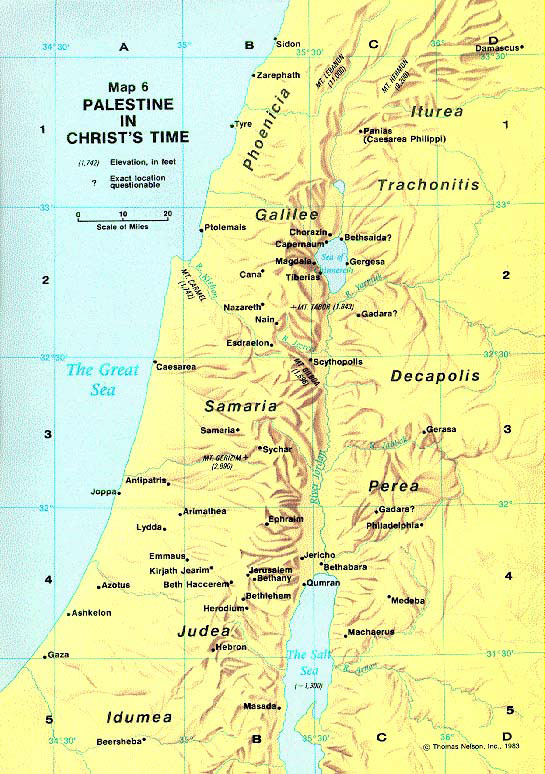 Judea was where Jerusalem was located. In Perea just across the Jordan
River to the east was the region where John the Baptizer had been active
earlier.
Judea was where Jerusalem was located. In Perea just across the Jordan
River to the east was the region where John the Baptizer had been active
earlier.
19:1-20:34
(6%) |
10:1-52
(8%) |
9:57-19:28
(35%) |
7:10-11:54
(28%) |
A. Early Judean Phase
| ---- |
---- |
9:57-13:21 |
7:10-10:39 |
|
|
67. Conversation
with would-be follower 9:57-62
68. Seventy sent out 10:1-16
69. Seventy returned 10:17-20
70. Jesus' thanksgiving 10:21-24
71. Parable of the Good Samaritan 10:25-37
72. Visit to Martha and Mary 10:38-42
73. Teaching on prayer 11:1-13
74. Beelzebub accusation 11:14-26
75. True blessedness 11:27-28
76. Demand for a sign 11:29-32
77. Light and darkness 11:33-36
78. Denouncing the Pharisees 11:37-54
79. Fearless confession 12:1-12
80. Parable of the rich fool 12:13-21
81. Earthly possessions and Heavenly treasure 12:22-34
82. Watching for the return of the Son of Man 12:35-48
83. The coming crisis 12:49-59
84. Need for repentance 13:1-9
85. Crippled woman healed 13:10-17
86. Parable of the mustard seed 13:18-19
87. Parable of the leaven 13:20-21 |
26.
Divided opinion at Feast of Tabernacles 7:10-13
27. Debate over Jesus' authority
7:14-24
28. Is He the Christ? 7:25-31
29. Officers sent to arrest Jesus
7:32-36
30. Offer of living water 7:37-39
31. Divided reaction of people
7:40-44
32. Rejection by religious leaders
7:45-52
[33. The woman caught in adultery
7:53-8:11]
34. Light of the world 8:12-20
35. Claim to authority 8:21-30
36. The truth will make you free
8:31-38
37. Your father the devil 8:39-47
38. Claim to deity 8:48-59
39. Blind man healed 9:1-12
40. Negative reaction to healing
9:13-34
41. Spiritual blindness 9:35-41
42. The sheepfold 10:1-6
43. The Good Shepherd 10:7-21
44. Debate in Solomon's Colonnade
10:22-39 |
The tenor for this section in
Luke is actually set in 9:51 with the statement, "When the days drew near
for him to be received up, he set his face to go up to Jerusalem" (RSV).
Thus Luke's "Last Journey to Jerusalem" (9:51-18:14) has a dark tone surrounding
it. The realization of death ahead in Jerusalem was very real for Jesus.
Although not looking forward to it, Jesus realized this was a significant
part of the Father's will for him and thus he began the journey southward
out of Galilee toward Jerusalem determined to not deviate from the Heavenly
Father's leadership over his life. In Luke's interpretation of the significance
of Jesus life and work, Jerusalem played a central role. It would be the
place where Jesus confronted the Jewish religious leadership head-on with
their departure from the divine will revealed in the Old Testament scriptures.
It would be the place where this confrontation resulted in Jesus' death
-- a seeming victory for the religious leaders. But a few days later this
seeming victory would be reversed in Jesus' glorious resurrection. Thus
Jerusalem would be the scene of Jesus' greatest triumph! Not the place
of his defeat!
This section in the Johannine
account begins with Jesus' attending the Feast of Tabernacles (#26). This
several day long festival began on Tishri 15, five days after Atonement;
this would be about mid-October on our calendar. This episode came
on the heels of a confrontation with his brothers in Galilee described
in Jn
10:1-9. Jesus' attendance at the festival was initially in secret without
letting anyone know he was present. But with his public teaching during
the middle of the celebration, he encountered confrontation and amazement
from the pilgrims attending the festival at the temple. The whole city
then engaged in a discussion over whether or not Jesus was the expected
Messiah (#28). The authorities sought to arrest him, but were unsuccessful
(##31-32). What followed in the Johannine narrative is a series of teachings
of Jesus with the healing of the blind man (#39). Jesus then retreated
east across the Jordan into Perea (#45).
The Lucan text (9:57-13:21)
is comprised mostly of a series of teachings of Jesus. Interspersed is
a visit to the home of Mary and Martha (#72) and the healing of a crippled
woman (#85).
B. Early Perean Phase
| ---- |
---- |
13:22-17:10 |
10:40-42 |
|
|
88. The narrow
gate into the kingdom 13:22-30
89. Warning against Herod 13:31-33
90. Lament over Jerusalem 13:34-35
91. Healing of a man with dropsy 14:1-6
92. Places of honor 14:7-11
93. Choice of guests 14:12-14
94. Parable of the great supper 14:15-24
95. Cost of discipleship 14:25-35
96. The criticism of the Pharisees 15:1-2
97. Parable of the lost sheep 15:3-7
98. Parable of the lost coin 15:8-10
99. Parable of the lost son 15:11-32
100. Parable of the unjust steward 16:1-9
101. Faithful stewardship 16:10-13
102. Rebuke of Pharisees 16:14-15
103. Law and the Kingdom 16:16-17
104. Divorce 16:18
105. Parable of the rich man and Lazarus 16:19-31
106. Stumbling blocks 17:1-2
107. Forgiveness 17:3-4
108. Faith 17:5-6
109. Parable of unprofitable servant 17:7-10 |
45.
Retreat into Perea 10:42-44 |
The Johannine text provides
little details about Jesus' activity in Perea (#45), apart from a busy
schedule of teaching with a positive response from the crowds who came
out to hear him. The lingering influence of John the Baptizer created an
openness to the teaching of Jesus that he did not experience in Jerusalem.
C. Later Judean Phase
| ---- |
---- |
---- |
11:1-54 |
|
|
|
46.
Delayed visit to Bethany 11:1-16
47. Conversation with Martha 11:17-27
48. Conversation with Mary 11:28-37
48. Lazarus raised 11:38-44
49. Plot to kill Jesus 11:45-53
50. Retreat to Ephraim 11:54 |
The exclusive Johannine source
for this information is contained in John 11, and focuses on the death
and raising of Lazarus. When Jesus arrived in Bethany just outside Jerusalem
he stepped back into dangerous territory. In the touching scene of him
showing concern and love for the two grieving sisters, one of the greatest
spiritual declarations uttered from his lips was made with the statement,
"I am the resurrection and the life. Those who believe in me, even though
they die, will live" (11:25, NRSV). In dramatic fashion Lazarus was raised
back to life, and this convinced some of the bystanders to believe in Jesus
(11:45). But it also prompted an assasination plot against him by the religious
leaders that forced Jesus to flee northward to the Samaritan town of Ephraim
(11:54). From here Jesus crossed over the Jordan River and joined the Jewish
pilgrims streaming down from Galilee headed to Jerusalem to celebrate the
Passover.
D. Later Perean Phase
The synoptic gospels, especially
Mark and Matthew, focus on the journey down the east bank of the Jordan
River from Galilee to Jericho before crossing the Jordan into the province
of Judea. This journey southward was to celebrate the Jewish Passover in
the springtime. Most all the pericopes in this section contain teaching
material, with the Twelve as a major target. See the above introductory
section for the double and triple tradition pericopes in this section.
| 19:1-20:34 |
10:1-52 |
17:11-19:27 |
---- |
119. Teaching
about divorce 19:1-12
120. Little children blessed 19:13-15
121. The rich young man 19:16-30
122. Parable of the workers 20:1-16
123. Prediction of death 20:17-19
124. Request of James and John 20:20-28
125. Two blind men healed 20:29-34 |
55.
Teaching about divorce 10:1-12
56. Little children blessed 10:13-16
57. The rich young man 10:17-31
58. Prediction of his death 10:32-34
59. Request of James and John 10:35-45
60. Blind Bartimaeus healed 10:46-52 |
110. Ten lepers
cleansed 17:11-19
111. Coming of the Kingdom 17:20-37
112. Parable of the widow and the unjust judge 18:1-8
113. Parable of the Pharisee and the publican 18:9-14
114. Little children blessed 18:15-17
115. The rich young man 18:18-30
116. Prediction of his death 18:31-34
117. Blind Bartimaeus healed 18:35-43
118. Zaccheus 19:1-10
119. Parable of the pounds 19:11-27 |
|
At this point in the Lucan
narrative both Mark and Matthew pick up the story line again. Notice here
that only some of the Lucan material overlaps Mark and Matthew creating
triple tradition.
|
Matthew 19:1-20:34
|
Mark 10:1-52 |
Luke 17:11-19:27 |
120. Little children
blessed 19:13-15
121. The rich young man 19:16-30
123. Prediction of death 20:17-19
125. Two blind men healed 20:29-34 |
56.
Little children blessed 10:13-16
57. The rich young man 10:17-31
58. Prediction of his death 10:32-34
60. Blind Bartimaeus healed 10:46-52 |
114. Little children
blessed 18:15-17
115. The rich young man 18:18-30
116. Prediction of his death 18:31-34
117. Blind Bartimaeus healed 18:35-43 |
Although these four pericopes
stand as triple tradition, they are inserted somewhat differently sequentially.
Luke follows his Marcan source sequentially at this point, whereas Matthew
reverses the sequence of the first two periocopes (#s 120 and 121). Additionally,
in Matthew's pattern, there are two men healed (#125) rather than just
one as in Mark (#60) and Luke (#117). This pericope merits further attention
as an illustration of tendencies in the synoptic gospel writers in the
use of their sources.
Blind Bartimaeus healed
(NRSV)
|
Matthew 20:29-34
|
Mark 10:46-52 |
Luke 18:34-43 |
| 29 As they were leaving
Jericho, a large crowd followed him. 30 There were two blind men sitting
by the roadside. When they heard that Jesus was passing by, they shouted,
"Lord, have mercy on us, Son of David!" 31 The crowd sternly ordered them
to be quiet; but they shouted even more loudly, "Have mercy on us, Lord,
Son of David!" 32 Jesus stood still and called them, saying, "What do you
want me to do for you?" 33 They said to him, "Lord, let our eyes be opened."
34 Moved with compassion, Jesus touched their eyes. Immediately they regained
their sight and followed him. |
46 They came
to Jericho. As he and his disciples and a large crowd were leaving Jericho,
Bartimaeus son of Timaeus, a blind beggar, was sitting by the roadside.
47 When he heard that it was Jesus of Nazareth, he began to shout out and
say, "Jesus, Son of David, have mercy on me!" 48 Many sternly ordered him
to be quiet, but he cried out even more loudly, "Son of David, have mercy
on me!" 49 Jesus stood still and said, "Call him here." And they called
the blind man, saying to him, "Take heart; get up, he is calling you."
50 So throwing off his cloak, he sprang up and came to Jesus. 51 Then Jesus
said to him, "What do you want me to do for you?" The blind man said to
him, "My teacher, let me see again." 52 Jesus said to him, "Go; your faith
has made you well." Immediately he regained his sight and followed him
on the way. |
35 As he approached Jericho,
a blind man was sitting by the roadside begging. 36 When he heard a crowd
going by, he asked what was happening. 37 They told him, "Jesus of Nazareth
is passing by." 38 Then he shouted, "Jesus, Son of David, have mercy on
me!" 39 Those who were in front sternly ordered him to be quiet; but he
shouted even more loudly, "Son of David, have mercy on me!" 40 Jesus stood
still and ordered the man to be brought to him; and when he came near,
he asked him, 41 "What do you want me to do for you?" He said, "Lord, let
me see again." 42 Jesus said to him, "Receive your sight; your faith has
saved you." 43 Immediately he regained his sight and followed him, glorifying
God; and all the people, when they saw it, praised God. |
This healing miracle of Jesus
is narrated by all three synoptic gospel writers, but in their own distinctive
ways. Several of these distinctives
surface with just a casual reading the the three depictions:
(1) Mark includes more narrative
details than either Matthew or Luke. This is rather typical of the Marcan
writing style. Althought the shortest of the three synoptic gospels, this
shortness is mainly due to the inclusion of fewer pericopes than either
Matthew or Luke and not because of brevity of narrative details inside
each of the overlapping pericopes with the other two gospel writers.
(2) Although all three gospel
writers locate this event as taking place in the town of Jericho (see above
map), they differ in the spatial location of the miracle. Mark (v. 46)
indicates that the miracle took place as Jesus and his disciples were leaving
Jericho. Matthew follows his Marcan source (v. 29), but Luke locates the
miracle as taking place as Jesus and his disciple were coming into Jericho
(vv. 35-36).
(3) Luke follows his Marcan
source indicating that a single individual was the recepient of Jesus'
healing action. Although Mark identifies him as "Bartimaeus
son of Timaeus, a blind beggar" (v. 46), Luke only picks up his blind condition
and his begging (v. 35). Matthew, however, describes "two blind
men sitting by the roadside" (v. 30). Matthew tends to identify Jesus'
actions as taking place with two individuals rather than one.
(4) Luke follows his Marcan
source by stressing the role that the faith of the blind man played in
the healing experience. Matthew, on the other hand, stresses the compassion
of Jesus as prompting the healing action.
Inspite of these distinctions,
the essential storyline of the healing
narrative is the same in all three gospels. (1) The beggars were sitting
by the roadside in Jericho as Jesus and his disciples passed by. (2) When
informed that Jesus was passing by, they began shouting out for Jesus to
take pity on them. (3) The people standing by them told them to be quiet
but more persistent cries were the response. (4) Jesus stopped and addressed
the beggars standing in front of them asking what they wanted from him.
(5) They replied that they wanted to see again. (6) Jesus honored the request
by granting sight to these blind men. (7) The healed men then followed
Jesus.
This pericope follows the
traditional structure of ancient miracle stories by (1) identifying the
need for miraculous action, (2) describing the miraculous action, and (3)
depiciting the results of the miraculous action on first the person in
need, and secondly upon the by-standers who witnessed the action (Luke
stresses this part). This is the 32nd miracle story of the 35
specific miracle narratives contained in the four gospels, highlighting
the tendency of the gospel writers to gradually reduce the number of miracles
narratives at they approach the accounting of the greatest miracle of all
that happened in the resurrection of Jesus.
Some of the pericopes in
this second stand only as double tradition, rather than triple tradition
material. These are charted below.
Agreements between Mark and Matthew
| Matthew
19:1-20:34 |
Mark
10:1-52 |
119. Teaching
about divorce 19:1-12
124. Request of James and John 20:20-28 |
55.
Teaching about divorce 10:1-12
59. Request of James and John 10:35-45 |
Matthew has followed his Marcan
source in the same sequence here, as well as including these two pericopes.
The Marcan "Teaching about divorce" (Mk. #55 & Mt. #119) has been alluded
to in abbreviated form in Luke 16:18 (#104) in the Early Perean Phase (sec.
B above), and the "Request of James and John" is not included in the Lucan
narrative at any point.
The Matthean M material
(i.e., found only in Matthew) is pericope #122 Parable of the workers 20:1-16,
while the uniquely Lucan material (L) includes pericopes
110. Ten lepers cleansed 17:11-19
111. Coming of the Kingdom 17:20-37
112. Parable of the widow and the unjust judge 18:1-8
113. Parable of the Pharisee and the publican 18:9-14
118. Zaccheus 19:1-10
119. Parable of the pounds 19:11-27
Thus we see Luke's tendency to use additional sources beyond Mark and Q
to supplement his story of Jesus. The result is many additional rich insights
about Jesus that we would otherwise have no knowledge of.
This final leg of the transitional
period of ministry between Galilee and the Passion Week in Jerusalem provides
us glimples into important teachings of Jesus, as well as reactions
of the masses of people as Jesus moved toward his fate at the hands of
the Jewish religious leaders and the Romans in Jerusalem.
3.2.5.5. The Final Week and Crucifixion (Passio
Christi)
The final seven days of Jesus'
earthly life are traditionally known as the Passio Christi (the Suffering
of Christ), since they narrate the events leading directly to his arrest
and crucifixion. As is obvious from the percentages listed below, these
seven days occupy a major place in the gospel accounts. Also, the four
gospel narratives are closer to one another in their description, both
in framework and narrative details, here than in any other segment elsewhere
in the story of Jesus.
The charting out of the
sequence of events during these seven days is easier than in other segments
of the story of Jesus in the gospels. Yet, some challenges do exist. One
of the difficulties has to do with the timing of the 'Annointing at Bethany'
pericope charted here on the first Saturday. This is based on the Johannine
narrative, rather than the synoptic narratives. In Mark and Matthew this
event would come on Tuesday evening after Jesus had finished the busy day
of teaching and confrontation in the temple inside Jerusalem. But the Johannine
sequence suggests the event took place at the end of the sabbath on Saturday
evening. See Jn. 12:1ff, "Six days before the Passover Jesus came to Bethany,
the home of Lazarus, whom he had raised from the dead. There they gave
a dinner for him...." Matthew and Mark do not provide as specific time
markers as does John. Another tension is the location of the event. In
Matthew and Mark, the dinner took place in the home of Simon the leper
(Mt. 26:6 and Mark 14:3), while in John the dinner was at the home of Lazarus
(Jh. 12:1). The tension between these spatial markers could suggest two
separate events, but the almost identical narrative details in the bulk
of the story across all three gospels make that hypothesis very unlikely.
Another challenge in this
segment of the Jesus' story has to do with the Johannine timing of the
Last Supper and thus of the crucifixion, over against that in the synoptic
gospels. The Johannine text suggests to some extent that the Last
Supper took place on Wednesday evening with the arrest and crucifixion
taking place the following day on Thursday. One possible indicator of this
comes in Jhn 13:1: "Now before the festival of the Passover..." naturally
suggests Wednesday evening, since the Passover celebration officially began
at sundown on Thursday evening. Yet, Jhn. 20:31 suggests that Jesus was
crucified on Friday, the day of Preparation for the Passover celebration
that concluded at sundown on Friday evening when the sabbath began. A.T.
Robertson in his A Harmony of the Gospels, pp. 281-284, has a helpful
synopsis of five critical texts in the fourth gospel that must be treated
in seeking a resolution of this issue: 13:1f.; 13:27; 18:28; 19:14; 19:31.
Many NT scholars are convinced that, although some natural tension does
exist here, the reconciliation of John with the synoptics on at least the
basics is possible without distorting the natural meaning of the texts.
Some awareness of the geography
of these events is important.
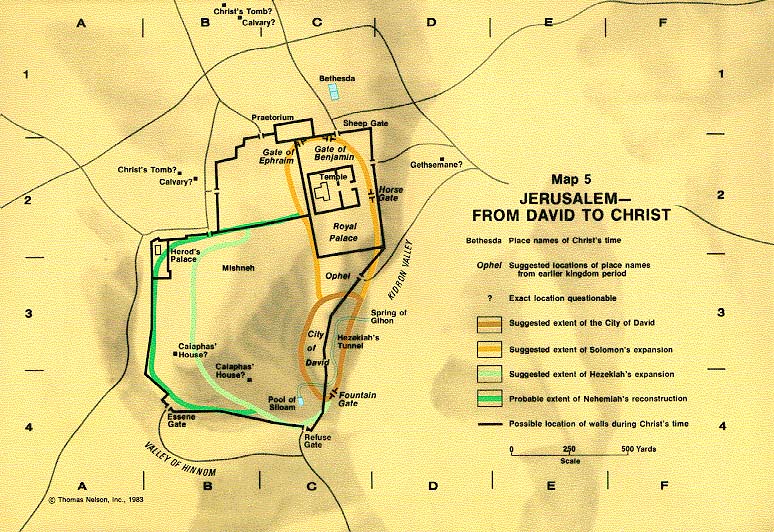 Bethany was located on the road to Jericho just east of the city itself.
Jesus and the disciples will spend each evening with friends in Bethany
and then walk the relatively short distance into the city of Jerusalem
each day, spending most of the time in or near the temple on the northeast
side of the city.
Bethany was located on the road to Jericho just east of the city itself.
Jesus and the disciples will spend each evening with friends in Bethany
and then walk the relatively short distance into the city of Jerusalem
each day, spending most of the time in or near the temple on the northeast
side of the city.
21:1-27:66
(34%) |
11:1-15:47
(34%) |
19:28-23:56
(20%) |
11:55-19:42
(33%) |
A. Friday, arrival at Bethany
| ---- |
---- |
---- |
11:55-57 |
|
|
|
51.
Plot against Jesus 11:55-57 |
John 11:55-57 details a plot
made against Jesus right at the outset of this final week of his earthly
life (NRSV): "55
Now the Passover of the Jews was near, and many went up from the country
to Jerusalem before the Passover to purify themselves. 56 They were looking
for Jesus and were asking one another as they stood in the temple, 'What
do you think? Surely he will not come to the festival, will he?' 57 Now
the chief priests and the Pharisees had given orders that anyone who knew
where Jesus was should let them know, so that they might arrest him."
Thus these final days of Jesus' life were cast under the dark cloud of
religious opposition to him that was actively seeking to apprehend him
in order to silence his message. In the synoptics, this same fate had been
already anticipated with the three separate occasions when Jesus had predicted
his arrest and death in Jerusalem: first prediction in Mk. 8:31-33 //Mt
16:21-23 // Lk 9:22; second prediction in Mk 9:30-32 //Mt 17:22-23 // Lk
9:43b-45 // Jn 7:1; third prediction in Mk 10:32-34 //Mt 20:17-19 //Lk
18:31-34.
B. Saturday, prophetic anointing
| 26:6-13 |
14:3-9 |
---- |
12:1-11 |
| 150. Anointing
at Bethany 26:6-13 |
79.
Anointing at Bethany 14:3-9 |
|
52.
Dinner at Bethany 12:1-8
53. Plot against Lazarus 12:9-11 |
For the sequential issue
of exactly when this took place see the introductory section above. Matthew
and Mark contain this episode, which somewhat parallels a similar one in
John. Luke omits any reference to it. John additionally details a plot
to kill Lazarus as well because of his witness after Jesus had raised him
from death.
| Mt. 26:6-13 |
Mk. 14:3-9 |
Jh 12:1-8 |
| 6 Now while Jesus was at
Bethany in the house of Simon the leper, 7 a woman came to him with an
alabaster jar of very costly ointment, and she poured it on his head as
he sat at the table. 8 But when the disciples saw it, they were angry and
said, "Why this waste? 9 For this ointment could have been sold for a large
sum, and the money given to the poor." 10 But Jesus, aware of this, said
to them, "Why do you trouble the woman? She has performed a good service
for me. 11 For you always have the poor with you, but you will not always
have me. 12 By pouring this ointment on my body she has prepared me for
burial. 13 Truly I tell you, wherever this good news is proclaimed in the
whole world, what she has done will be told in remembrance of her." |
3 While he was at Bethany
in the house of Simon the leper, as he sat at the table, a woman came with
an alabaster jar of very costly ointment of nard, and she broke open the
jar and poured the ointment on his head. 4 But some were there who said
to one another in anger, "Why was the ointment wasted in this way? 5 For
this ointment could have been sold for more than three hundred denarii,
and the money given to the poor." And they scolded her. 6 But Jesus said,
"Let her alone; why do you trouble her? She has performed a good service
for me. 7 For you always have the poor with you, and you can show kindness
to them whenever you wish; but you will not always have me. 8 She has done
what she could; she has anointed my body beforehand for its burial. 9 Truly
I tell you, wherever the good news is proclaimed in the whole world, what
she has done will be told in remembrance of her." |
1 Six days before the Passover Jesus came to Bethany, the home of Lazarus,
whom he had raised from the dead. 2 There they gave a dinner for him. Martha
served, and Lazarus was one of those at the table with him. 3 Mary took
a pound of costly perfume made of pure nard, anointed Jesus' feet, and
wiped them with her hair. The house was filled with the fragrance of the
perfume. 4 But Judas Iscariot, one of his disciples (the one who was about
to betray him), said, 5 "Why was this perfume not sold for three hundred
denarii and the money given to the poor?" 6 (He said this not because he
cared about the poor, but because he was a thief; he kept the common purse
and used to steal what was put into it.) 7 Jesus said, "Leave her alone.
She bought it so that she might keep it for the day of my burial. 8 You
always have the poor with you, but you do not always have me." |
To be certain, several temporal
and spatial challenges exist in this pericope. The Marcan and Matthean
sequence places this on Tuesday evening, rather than Saturday evening as
does John. The location of the dinner is in the home of Simon the leper
in Mark and Matthew, while it was in the home of Lazarus in John. An unnamed
woman annointed Jesus in Mark and Matthew, while she is identified as Mary,
the sister of Martha in John. The annointing was of Jesus' head in Mark
and Matthew, while it was of Jesus' feet in John. Mark and John identify
the value of the spices as 300 denarii while Matthew simply says a large
sum. In Matthew the disciples fuss about this action being wasteful, while
Mark leaves the hostile reaction more general, "some who were there...".
John, however, identifies the protestor as Judas. All three gospels record
a somewhat similar response by Jesus: it was a preparation of Jesus for
his burial after crucifixion. Mark and Matthew add the extra statement
that this woman will always be remembered for her kind, thoughtful action
toward Jesus. These differences, while not making an adequate argument
to two separate events, do present difficulties in understanding the details
of the events of that evening.
The essential point of these
narratives, however, is clear: Jesus affirmed the action of the woman who
had more spiritual perception about coming events than did his own disciples.
She had made great sacrifice both financially and action wise in order
to show her compassion for Jesus. Their negative reaction, while within
the boundaries of Jewish law and expectations for genuine piety among Jews
of that day, missed an important point. The benevolent action of giving
to the poor in Jewish tradition was more motivated by the desire to accumulate
'good works' against the day of final judgment, than it was an expression
of concern for the poor. Jesus' reaction was aware of these issues and
he refocused attention back on the sincere expression of compassion by
the woman.
In the Johannine narrative,
Jesus' presence in Bethany was made known to a large number of people who
responded with curiosity to both him and Lazarus [Jn 12:9-11 (NRSV)]: "9
When the great crowd of the Jews learned that he was there, they came not
only because of Jesus but also to see Lazarus, whom he had raised from
the dead. 10 So the chief priests planned to put Lazarus to death as well,
11 since it was on account of him that many of the Jews were deserting
and were believing in Jesus." The determination
of the religious leaders to eliminate the influence of Jesus reached bazaar
levels when they resorted to plotting murder. Something should have clicked
in their heads: "Look, our anger is leading us to violate one of the most
basic laws of the Torah." But it didn't, and they persued their intention
to get rid of Jesus. If nothing else, this passage warns us about the power
of religion and anger. When mixed together at high levels, a volatile combination
is created that can produce horrifically evil actions.
C. Sunday, Messianic Manifestation
| 21:1-11 |
11:1-11 |
19:28-44 |
12:12-19 |
126. Triumphal
entry into Jerusalem 21:1-11
127. Cleansing the temple 21:12-17 |
61.
Triumphal entry into Jerusalem 11:1-11 |
120. Triumphal
entry into Jerusalem 19:28-44
121. Cleansing the temple 19:45-46 |
54.
Triumphal entry into Jerusalem 12:12-19 |
Palm Sunday, as it is labeled
among Christians today, was a celebratory time that created high excitement
in the city of Jerusalem. All four gospel accounts record this event, while
preserving their individual perspective in narrating this significant evet.
| Mt 21:1-11 |
Mk 11:1-11 |
Lk 19:28-44 |
Jn 12:12-19 |
| 1 When they had come near
Jerusalem and had reached Bethphage, at the Mount of Olives, Jesus sent
two disciples, 2 saying to them, "Go into the village ahead of you, and
immediately you will find a donkey tied, and a colt with her; untie them
and bring them to me. 3 If anyone says anything to you, just say this,
"The Lord needs them.' And he will send them immediately. " 4 This took
place to fulfill what had been spoken through the prophet, saying, 5 "Tell
the daughter of Zion, Look, your king is coming to you, humble, and mounted
on a donkey, and on a colt, the foal of a donkey." 6 The disciples went
and did as Jesus had directed them; 7 they brought the donkey and the colt,
and put their cloaks on them, and he sat on them. 8 A very large crowd
spread their cloaks on the road, and others cut branches from the trees
and spread them on the road. 9 The crowds that went ahead of him and that
followed were shouting, "Hosanna to the Son of David! Blessed is the one
who comes in the name of the Lord! Hosanna in the highest heaven!" 10 When
he entered Jerusalem, the whole city was in turmoil, asking, "Who is this?"
11 The crowds were saying, "This is the prophet Jesus from Nazareth in
Galilee." |
1 When they were approaching
Jerusalem, at Bethphage and Bethany, near the Mount of Olives, he sent
two of his disciples 2 and said to them, "Go into the village ahead of
you, and immediately as you enter it, you will find tied there a colt that
has never been ridden; untie it and bring it. 3 If anyone says to you,
"Why are you doing this?' just say this, "The Lord needs it and will send
it back here immediately.' " 4 They went away and found a colt tied near
a door, outside in the street. As they were untying it, 5 some of the bystanders
said to them, "What are you doing, untying the colt?" 6 They told them
what Jesus had said; and they allowed them to take it. 7 Then they brought
the colt to Jesus and threw their cloaks on it; and he sat on it. 8 Many
people spread their cloaks on the road, and others spread leafy branches
that they had cut in the fields. 9 Then those who went ahead and those
who followed were shouting, "Hosanna! Blessed is the one who comes in the
name of the Lord! 10 Blessed is the coming kingdom of our ancestor David!
Hosanna in the highest heaven!" 11 Then he entered Jerusalem and went into
the temple; and when he had looked around at everything, as it was already
late, he went out to Bethany with the twelve. |
28 After he had said this,
he went on ahead, going up to Jerusalem. 29 When he had come near Bethphage
and Bethany, at the place called the Mount of Olives, he sent two of the
disciples, 30 saying, "Go into the village ahead of you, and as you enter
it you will find tied there a colt that has never been ridden. Untie it
and bring it here. 31 If anyone asks you, "Why are you untying it?' just
say this, "The Lord needs it.' " 32 So those who were sent departed and
found it as he had told them. 33 As they were untying the colt, its owners
asked them, "Why are you untying the colt?" 34 They said, "The Lord needs
it." 35 Then they brought it to Jesus; and after throwing their cloaks
on the colt, they set Jesus on it. 36 As he rode along, people kept spreading
their cloaks on the road. 37 As he was now approaching the path down from
the Mount of Olives, the whole multitude of the disciples began to praise
God joyfully with a loud voice for all the deeds of power that they had
seen, 38 saying, "Blessed is the king who comes in the name of the Lord!
Peace in heaven, and glory in the highest heaven!" 39 Some of the Pharisees
in the crowd said to him, "Teacher, order your disciples to stop." 40 He
answered, "I tell you, if these were silent, the stones would shout out."
41 As he came near and saw
the city, he wept over it, 42 saying, "If you, even you, had only recognized
on this day the things that make for peace! But now they are hidden from
your eyes. 43 Indeed, the days will come upon you, when your enemies will
set up ramparts around you and surround you, and hem you in on every side.
44 They will crush you to the ground, you and your children within you,
and they will not leave within you one stone upon another; because you
did not recognize the time of your visitation from God." |
12 The next day the great
crowd that had come to the festival heard that Jesus was coming to Jerusalem.
13 So they took branches of palm trees and went out to meet him, shouting,
"Hosanna! Blessed is the one who comes in the name of the Lord — the King
of Israel!" 14 Jesus found a young donkey and sat on it; as it is written:
15 "Do not be afraid, daughter of Zion. Look, your king is coming, sitting
on a donkey's colt!" 16 His disciples did not understand these things at
first; but when Jesus was glorified, then they remembered that these things
had been written of him and had been done to him. 17 So the crowd that
had been with him when he called Lazarus out of the tomb and raised him
from the dead continued to testify. 18 It was also because they heard that
he had performed this sign that the crowd went to meet him. 19 The Pharisees
then said to one another, "You see, you can do nothing. Look, the world
has gone after him!" |
When Jesus entered Jerusalem
on this Sunday morning, the pattern and the strategy was different from
what it would be the remaining days when he would return to Jerusalem each
morning from Bethany. This first morning after the Jewish sabbath day he
made a triumphal entry into the city presenting himself in prophetic fulfillment
as the promised Annointed One who had come to bring deliverance to God's
people. Matthew cast this in the framework of Isaiah 62 11 [10
Go through, go through the gates, prepare the way for the people; build
up, build up the highway, clear it of stones, lift up an ensign over the
peoples. 11 The Lord has proclaimed to the end of the earth: Say
to daughter Zion, "See, your salvation comes;
his reward is with him, and his recompense before him."] and
Zech. 9:9
[9 Rejoice greatly, O daughter Zion! Shout aloud, O daughter Jerusalem!
Lo, your king comes to you;
triumphant and victorious is he, humble and
riding on a donkey, on a colt, the foal of a donkey.
10 He will cut off the chariot from Ephraim and the war-horse from
Jerusalem; and the battle bow shall be cut off, and he shall command peace
to the nations; his dominion shall be from sea to sea, and from the River
to the ends of the earth.]. This was a part of
a popular stream of Jewish messianic expectation current in Jesus' day
that the long-awaited Messiah would make his appearance during the Passover,
assembing an army on the Mount of Olives then entering the Holy City to
cast out all foreign, corrupting influence. From Jerusalem he would begin
a deliverance of the Promised Land that would restore the Israelite nation
to its glory days during the reigns of David and Solomon. Thus Jesus' manner
of entering the city symbolically suggested to the throngs of people present
for Passover celebration that he was claiming to be their Messiah. And
their response described in all four gospel accounts suggests that they
so understood the actions of Jesus. He made his entrance much to the shock
and dismay of the religious authorities. Their fear was mostly that Jesus
would create an uproar in the city that would bring down harsh, swift retribution
from the Roman authorties who held the religious leaders responsibile first
and foremost for keeping order during times of religious celebration.
The second episode on this
day was the cleansing of the temple, recorded here only in Matthew and
Luke.
D. Monday, Messianic Authority
| 21:12-22 |
11:12-18 |
19:45-48 |
12:20-50 |
| 128. Cursing
the fig tree 21:18-22 |
62.
Cursing the fig tree 11:12-14
63. Cleansing the temple 11:15-18 |
122. Daily teaching
in the temple 19:47-48 |
55.
Request of some Greeks 12:20-26
56. Jesus' commitment to the passion
12:27-36a
57. Rejection of Jesus in unbelief
12:36b-43
58. Unbelief judged 12:44-50 |
E. Tuesday, Controversy and Teaching
| 21:23-26:16 |
11:19-14:11 |
20:1-22:6 |
---- |
129. Objections
raised by Sanhedrin 21:23
130. Dilemma of John's authority 21:24-27
131. Parable of the two sons 21:28-32
132. Parable of the wicked tenants 21:33-46
133. Parable of the great supper 22:1-14
134. Paying taxes to Caesar 22:15-22
135. Question about the resurrection 22:23-33
136. The greatest commandment 22:34-40
137. David's son 22:41-46
138. Denouncing the scribes and Pharisees 23:1-36
139. Lament over Jerusalem 23:37-39
140. Temple destruction predicted 24:1-2
141. Signs of the Times 24:3-31
142. Lesson of the fig tree 24:32-35
143. The unknown day
and hour 24:36-44
144. Parable of the unfaithful servant 24:45-51
145. Parable of the ten virgins 25:1-12
146. Parable of the talents 25:13-30
147. Judgment of the sheep and goats 25:31-46
148. Prediction of death 26:1-2
149. Plot of the Sanhedrin 26:3-5
-------------------------------------------
151. Betrayal agreement 26:14-16 |
64.
Lessons from the fig tree 11:19-25
65. Objections raised by Sanhedrin
11:27-28
66. Dilemma of John's authority
11:29-33
67. Parable of the wicked tenants
12:1-12
68. Paying taxes to Caesar 12:13-17
69. Question about the resurrection
12:18-27
70. The greatest commandment 12:28-34
71. David's son 12:35-37
72. Denouncing the scribes 12:38-40
73. The widow's offering 12:41-44
74. Temple destruction predicted
13:1-2
75. Signs of the times 13:3-27
76. Lesson of the fig tree 13:28-31
77. The
unknown day and hour 13:32-37
78. Plot of the Sanhedrin 14:1-2
-------------------------------------------
80. Betrayal agreement 14:10-11 |
123. Objections
raised by Sanhedrin 20:1-2
124. Dilemma of John's authority 20:3-8
125. Parable of the wicked tenants 20:9-18
126. Paying taxes to Caesar 20:19-26
127. Question about the resurrection 20:27-40
128. David's son 20:41-44
129. Denouncing the scribes 20:45-47
130. The widow's offering 21:1-4
131. Temple destruction predicted 21:5-6
132. Signs of the times 21:7-28
133. Lesson of the fig tree 21:29-33
134. Be ready 21:34-36
135. Teaching ministry in the temple 21:37-38
136. Plot of the Sanhedrin 22:1-2
137. Betrayal agreement 22:3-6 |
|
F. Wednesday, rest (no record)
G. Thursday, farewells
| 26:17-46 |
14:12-42 |
22:7-46 |
13:1-17:26 |
152. Last Supper
Preparations 26:17-19
153. Prediction of betrayal 26:20-25
154. Institution of Lord's Supper 26:26-30
155. Prediction of Peter's denial 26:31-35
156. Gethsemane 26:36-46 |
81.
Last Supper Preparations 14:12-16
82. Prediction of betrayal 14:17-21
83. Institution of Lord's Supper
14:27-31
84. Prediction of Peter's denial
14:27-31
85. Gethsemane 14:32-42 |
138. Last Supper
Preparations 22:7-13
139. Passover meal 22:14-18
140. Institution of Lord's Supper 22:19-20
141. Prediction of betrayal 22:21-23
142. Dispute about greatness 22:24-27
143. Future role in the Kingdom 22:28-30
144. Prediction of Peter's denial 22:31-34
145. Two swords 22:35-38
146. Gethsemane 22:39-46 |
59.
Last Supper: Disciples' feet washed 13:1-20
60. Last Supper: Prediction of
betrayal 13:21-30
61. The new commandment 13:31-35
62. Prediction of Peter's denial
13:36-38
63. Question of Thomas 14:1-8
64. Request of Philip 14:9-14
65. The promise of the Spirit 14:15-21
66. Question of Judas 14:22-24
67. Parting words of comfort 14:25-31
68. Abiding in love bears fruit
15:1-17
69. Expecting the hatred of the
world 15:18-16:4a
70. Being encouraged and taught
by the Spirit 16:4b-15
71. Paradoxical discipleship 16:16-24
72. Overcoming the world 16:25-33
73. High priestly prayer 17:1-26 |
H. Friday, Redemptive Accomplishment
| 26:47-27:61 |
14:43-15:47 |
22:47-23:56 |
18:1-19:42 |
157. Arrest in
the garden 26:47-56
158. Trial before Caiaphas 26:57-68
159. Peter's denial 26:69-75
160. Trial before Sanhedrin 27:1-2
161. Judas' death 27:3-10
162. Trial before Pilate 27:11-26
163. Mockery of the soldiers 27:27-31
164. Simon of Cyrene 27:32
165. Vinegar refused 27:33-34
166. Parting his garments 27:35
167. His accusation 27:36-37
168. Two thieves 27:38
169. Mockery 27:39-44
170. Jesus' Death 27:45-50
171. Temple veil torn 27:51
172. Resurrection of saints 27:52-53
173. Centurion's declaration 27:54
174. Women watched 27:55-56
175. Burial 27:57-61 |
86.
Arrest in the garden 14:43-50
87. The young man who fled 14:51-52
88. Trial before the high priest
14:53-65
89. Peter's denial 14:66-72
90. Trial before the Sanhedrin
15:1
91. Trial before Pilate 15:2-15
92. Mockery of the soldiers 15:16-20
93. Simon of Cyrene 15:21
94. Wine refused 15:22-23
95. Parting his garments 15:24
96. His accusation 15:25-26
97. Two thieves 15:27-28
98. Mockery 15:29-32
99. Jesus' Death 15:33-37
100. Temple veil torn 15:38
101. Centurion's declaration 15:39
102. Women watched 15:40-41
103. Burial 15:42-47 |
147. Arrest in
the garden 22:47-53
148. Peter's denial 22:54-62
149. Mockery in high priest's house 22:63-65
150. Trial before the Sanhedrin 22:66-71
151. Trial before Pilate 23:1-5
152. Trial before Herod 23:6-12
153. Trial before Pilate 23:13-25
154. Simon of Cyrene 23:26
155. Words to the women 23:27-31
156. Two thieves 23:32-33
157. Parting his garments 23:34
158. Mockery 23:35-57
159. His accusation 23:38
160. Repentant thief 23:39-43
161. Death 23:44-46
162. Centurion's declaration 23:47
163. People's response 23:48
164. Disciples and women watch 23:49
165. Burial 23:50-56 |
74.
Arrest in the garden 18:1-11
75. Trial before Annas (1) 18:12-14
76. Peter's denial (1) 18:15-18
77. Trial before Annas (2) 18:19-24
78. Peter's denial (2) 18:25-27
79. Trial before Pilate 18:28-38a
80. Jesus sentenced to die 18:38b-19:16a
81. Way to Golgotha 19:16b-17
82. Two thieves 19:18
83. His accusation 19:19-22
84. Parting his garments 19:23-24
85. Women watched 19:25
86. Jesus' word to Mary 19:26-27
87. Vinegar accepted 19:28-29
88. Death 19:30
89. Jesus' side pierced 19:31-37
90. Burial 19:38-42 |
I. Saturday,
Guard posted at the Tomb
| 27:62-66 |
---- |
---- |
---- |
| 176. Guard at
the tomb 27:62-66 |
|
|
|
(NRSV):
62 The next day, that is, after the day of Preparation, the chief priests
and the Pharisees gathered before Pilate 63 and said, "Sir, we remember
what that impostor said while he was still alive, "After three days I will
rise again.' 64 Therefore command the tomb to be made secure until the
third day; otherwise his disciples may go and steal him away, and tell
the people, "He has been raised from the dead,' and the last deception
would be worse than the first." 65 Pilate said to them, "You have a guard
of soldiers; go, make it as secure as you can." 66 So they went with the
guard and made the tomb secure by sealing the stone.
3.2.5.6. Resurrection and Appearances
28:1-20
(2%) |
16:1-20
(3%) |
24:1-53
(5%) |
20:1-21:25
(6%) |
The story of Jesus' resurrection
is told around two frames of reference in all four gospels: (1) the depiction
of the resurrection with the women as the initial witnesses, and (2) isolated
appearances of the resurrected Jesus to his disciples. The one exception
to this pattern is the Gospel of Mark, which in its original version ended
at 16:8 with the witness of the women to the resurrected Jesus. Verses
9-20, the so-called Longer Ending, were added several centuries after the
original writing of the document in order to make Mark end like the other
gospels did. For more details, see below under section B.
A. The Empty Tomb
For a more detailed study
of the Empty Tomb pericope in each of the gospel accounts see "Encounters"
(based on Mt. 28:1-10) and "Easter
Sunday" (based on Lk. 24:1-12) Bible studies which were taught initially
as Sunday School lessons at the First Baptist Church of Shelby, NC. These
files are in the Adobe pdf format.
| 28:1-10 |
16:1-8 |
24:1-12 |
20:1-10 |
| 177. Resurrection
appearance to Mary Magdalene and the other Mary 28:1-10 |
104.
Angelic appearance to Mary Magdalene and the other Mary 16:1-8 |
166. Angelic
appearance to the women 24:1-12 |
91.
Discovery of empty tomb by Mary Magdalene 20:1-10 |
Resurrection morning is
not described in great detail, at least what happened inside the tomb where
Jesus' dead body lay. Instead, the impact of Jesus coming back to live
in a new glorified body is the focus of all four gospel accounts. Yet,
each gospel writer has a distinct perspective on these events, as is evident
from the table below listing the scripture texts:
| Matthew 28:1-10 |
Mark 16:1-8 |
Luke 24:1-12 |
John 20:1-10 |
|
1 After the sabbath, as the first day of the week was dawning, Mary Magdalene
and the other Mary went to see the tomb. 2 And suddenly there was a great
earthquake; for an angel of the Lord, descending from heaven, came and
rolled back the stone and sat on it. 3 His appearance was like lightning,
and
his clothing white as snow. 4 For fear of him the guards shook and became
like dead men. 5 But the angel said to the women, "Do not be afraid; I
know that you are looking for Jesus who was crucified. 6 He is not here;
for he has been raised, as he said. Come, see the place where he F219
lay.
7 Then go quickly and tell his disciples, "He has been raised from the
dead,F220 and indeed he is going ahead of you to Galilee; there
you will see him.' This is my message for you." 8 So they left the tomb
quickly with fear and great joy, and ran to tell his disciples. 9 Suddenly
Jesus met them and said, "Greetings!" And they came to him, took hold of
his feet, and worshiped him. 10 Then Jesus said to them, "Do not be afraid;
go and tell my brothers to go to Galilee; there they will see me." |
1 When the sabbath was over, Mary Magdalene, and Mary the mother of James,
and Salome bought spices, so that they might go and anoint him. 2 And very
early on the first day of the week, when the sun had risen, they went to
the tomb. 3 They had been saying to one another, "Who will roll away the
stone for us from the entrance to the tomb?" 4 When they looked up, they
saw that the stone, which was very large, had already been rolled back.
5 As they entered the tomb, they saw a young man, dressed in a white robe,
sitting on the right side; and they were alarmed. 6 But he said to them,
"Do not be alarmed; you are looking for Jesus of Nazareth, who was crucified.
He has been raised; he is not here. Look, there is the place they laid
him. 7 But go, tell his disciples and Peter that he is going ahead of you
to Galilee; there you will see him, just as he told you." 8 So they went
out and fled from the tomb, for terror and amazement had seized them; and
they said nothing to anyone, for they were afraid.F136 |
1 But on the first day of the week, at early dawn, they came to the tomb,
taking the spices that they had prepared. 2 They found the stone rolled
away from the tomb, 3 but when they went in, they did not find the body.F200
4 While they were perplexed about this, suddenly two men in dazzling clothes
stood beside them. 5 The womenF201 were terrified and bowed
their faces to the ground, but the menF202 said to them, "Why
do you look for the living among the dead? He is not here, but has risen.
F203
6 Remember how he told you, while he was still in Galilee, 7 that the Son
of Man must be handed over to sinners, and be crucified, and on the third
day rise again." 8 Then they remembered his words, 9 and returning from
the tomb, they told all this to the eleven and to all the rest. 10 Now
it was Mary Magdalene, Joanna, Mary the mother of James, and the other
women with them who told this to the apostles. 11 But these words seemed
to them an idle tale, and they did not believe them. 12 But Peter got up
and ran to the tomb; stooping and looking in, he saw the linen cloths by
themselves; then he went home, amazed at what had happened.F204 |
1 Early on the first day of the week, while it was still dark, Mary Magdalene
came to the tomb and saw that the stone had been removed from the tomb.
2 So she ran and went to Simon Peter and the other disciple, the one whom
Jesus loved, and said to them, "They have taken the Lord out of the tomb,
and we do not know where they have laid him." 3 Then Peter and the other
disciple set out and went toward the tomb. 4 The two were running together,
but the other disciple outran Peter and reached the tomb first. 5 He bent
down to look in and saw the linen wrappings lying there, but he did not
go in. 6 Then Simon Peter came, following him, and went into the tomb.
He saw the linen wrappings lying there, 7 and the cloth that had been on
Jesus' head, not lying with the linen wrappings but rolled up in a place
by itself. 8 Then the other disciple, who reached the tomb first, also
went in, and he saw and believed; 9 for as yet they did not understand
the scripture, that he must rise from the dead. 10 Then the disciples returned
to their homes. |
FOOTNOTES:
F219: Other ancient authorities read [the Lord]
F220: Other ancient authorities lack [from the dead] |
FOOTNOTES:
F136: Some of the most ancient authorities bring the
book to a close at the end of verse 8. One authority concludes the book
with the shorter ending; others include the shorter ending and then continue
with verses 9-20. In most authorities verses 9-20 follow immediately after
verse 8, though in some of these authorities the passage is marked as being
doubtful. |
FOOTNOTES:
F200: Other ancient authorities add [of the Lord Jesus]
F201: Gk [They]
F202: Gk [but they]
F203: Other ancient authorities lack [He is not here,
but has risen]
F204: Other ancient authorities lack verse 12 |
|
As these verses clearly indicate, each gospel writer had individual sources
that they drew from. Still the basic elements and characters of the story
are in common: (1) angels and (2) women going to the tomb. Matthew adds
a personal encounter of the women with Jesus (Mt. 28:9-10). John will have
a version of this in the subsequent pericope in his narrative. Luke and
John contain segments narrating Peter and/or Peter and John coming to the
tomb to check out the story of the women. In all accounts the women first
went to Peter and the disciples to report what they had seen. Their reaction
is handled somewhat differently by the gospel writers.
The
individual distinctives especially surface with the different narrative
details about these two basic elements. Each gospel writer has a different
way to describe the angel(s) who were present. Although some of the women's
names appear in common as composing those who went to the tomb, the gospel
writers will include different names or different numbers of women who
were present.
Matthew
comes the closest to describing the resurrection moment itself when he
associated it with an earthquake and the descent of the angel who rolled
away the stone blocking the entrance to the tomb.
Time
and some place markers in the narrative will differ somewhat. For Matthew
it was "After the sabbath, as the first day of the week was dawning..."
But Mark states "When the sabbath was over,.... 2 And very early on the
first day of the week, when the sun had risen,..." Luke's perspective is
"1 But on the first day of the week, at early dawn,..." John has a somewhat
different take on the situation with his "Early on the first day of the
week, while it was still dark,..."
In order to more fully comprehend
the historical/literary issues involved in this pericope, you need to complete
the following analysis:
|
Matthew |
Mark |
Luke |
John |
1) S1-empty tomb scene verses:
Time it took place:
After
the sabbath:
First
day of the week:
Just as
the sun war rising:
After
the sun had risen:
While
it was still dark:
Earthquake mentioned
Guards fainted
Angelic instructions:
Don’t be afraid
He is risen
See where he was laid
Go tell
his disciples
Meet Jesus
in Galilee |
verses: 1-7
_____
_____
_____
_____
_____
_____
_____
_____
_____
_____
_____
_____
_____
_____
|
verses: 1-7
_____
_____
_____
_____
_____
_____
_____
_____
_____
_____
_____
_____
_____
_____
|
verses: 1-7
_____
_____
_____
_____
_____
_____
_____
_____
_____
_____
_____
_____
_____
_____
|
verses: 1
_____
_____
_____
_____
_____
_____
_____
_____
_____
_____
_____
_____
_____
_____
|
2) S2-Women’s Departure scene
Jesus’ appeared to women:
They flee in fear not speaking: |
verses: 8-10
_____
_____
|
verse: 8
_____
_____
|
|
|
3) S3-Women’s report scene
Report to the entire group:
Report to Peter & John: |
|
|
verses: 8-11
_____
_____
|
verse: 2
_____
_____
|
4) S4-disciples’ tomb visit scene:
Looking into the tomb:
Going into the tomb: |
------------------
------------------
------------- |
|
verse: 12a
_____
_____
|
verses: 3-10a
_____
_____
|
5) S5-disciples’ return home
The disciples return home |
|
|
verse: 12b
_____
|
verse: 10b
_____
|
6) Identity of the women:
Mary Magdalene:
other Mary
Mary, mother of James
Joanna
Salome
other women |
_____
_____
_____
_____
_____
_____
_____
|
_____
_____
_____
_____
_____
_____
_____
|
_____
_____
_____
_____
_____
_____
_____
|
_____
_____
_____
_____
_____
_____
_____
|
7) Identity of messengers:
angel of the Lord
young man dressed in white robe
two men in dazzling clothes |
_____
_____
_____
_____
|
_____
_____
_____
_____
|
_____
_____
_____
_____
|
_____
_____
_____
_____
|
B. The Appearances to His Disciples
| 28:9-20 |
(16:9-20) |
24:13-53 |
20:11-21:25 |
This second section
contains, mostly, a series of appearances by Jesus to different segments
of his disciples at different times and in various locations.The one exception
is the first pericope recorded by Matthew in 28:11-15. Matthew seeks to
provide proof of Jesus' resurrection by recounting the report of those
guarding Jesus' tomb to the temple authorities. The remaining pericopes,
then, describe appearances of the resurrected Jesus. Interestingly, no
duplication of accounts exist, apart from the so-called 'Longer Ending'
of Mark 16:8-20. This text was a much later addition to the gospel of Mark,
which originally ended at 16:8.
Before examining the
various pericopes, the issue of the ending of Mark needs some attention.
The issue relates to what was added later to the second gospel in order
to bring the document to a close more like the other three gospels. By
the fifth century of the Christian era individuals were becoming increasingly
uncomfortable with the seeminly 'abrupt' ending of the Marcan gospel with
the empty tomb narrative and the closing statement regarding the women
who had seen the angel at the tomb of Jesus: "So
they went out and fled from the tomb, for terror and amazement had seized
them; and they said nothing to anyone, for they were afraid."Consequently,
revisions of this gospel began appearing which provided a more common type
ending of the gospel with resurrection appearances to the apostles. Two
essential versions -- with numerous variations of each -- began showing
up in the various manuscript copies of the Marcan gospel.
The
so-called 'shorter version' reads (NRSV):"And
all that had been commanded them they told briefly to those around Peter.
And afterward Jesus himself sent out throught them, from east to west,
the sacred and imperishable proclamation of eternal salvation."Although
this version naturally brings the gospel to a close, the language of the
words, especially in the second sentence, reflect later church father kinds
of expressions which are never found anywhere else in the New Testament.
This, coupled with the very late and insignificant manuscript evidence,
leaves the likelihood of this being a part of the original writing of the
document virtually impossible.
The
so-called 'longer version' reads (NRSV):
"9 #[Now
after he rose early on the first day of the week, he appeared first to
Mary Magdalene, from whom he had cast out seven demons. 10 She went out
and told those who had been with him, while they were mourning and weeping.
11 But when they heard that he was alive and had been seen by her, they
would not believe it. 12 After this he appeared in another form to two
of them, as they were walking into the country. 13 And they went back and
told the rest, but they did not believe them.
14 Later he appeared
to the eleven themselves as they were sitting at the table; and he upbraided
them for their lack of faith and stubbornness, because they had not believed
those who saw him after he had risen.F137 15 And he said to
them, "Go into all the world and proclaim the good newsF138
to the whole creation. 16 The one who believes and is baptized will be
saved; but the one who does not believe will be condemned. 17 And these
signs will accompany those who believe: by using my name they will cast
out demons; they will speak in new tongues; 18 they will pick up snakes
in their hands,F139 and if they drink any deadly thing, it will
not hurt them; they will lay their hands on the sick, and they will recover."
19 So then the Lord
Jesus, after he had spoken to them, was taken up into heaven and sat down
at the right hand of God. 20 And they went out and proclaimed the good
news everywhere, while the Lord worked with them and confirmed the message
by the signs that accompanied it.F140 #]
-------------------------
FOOTNOTES:
F136:
Some of the most ancient authorities bring the book to a close at the end
of verse 8. One authority concludes the book with the shorter ending; others
include the shorter ending and then continue with verses 9-20. In most
authorities verses 9-20 follow immediately after verse 8, though in some
of these authorities the passage is marked as being doubtful.
F137:
Other ancient authorities add, in whole or in part, [And they excused themselves,
saying, "This age of lawlessness and unbelief is under Satan, who does
not allow the truth and power of God to prevail over the unclean things
of the spirits. Therefore reveal your righteousness now"--thus they spoke
to Christ. And Christ replied to them, "The term of years of Satan's power
has been fulfilled, but other terrible things draw near. And for those
who have sinned I was handed over to death, that they may return to the
truth and sin no more, that they may inherit the spiritual and imperishable
glory of righteousness that is in heaven."]
F138:
Or [gospel]
F139:
Other ancient authorities lack [in their hands]
F140:
Other ancient authorities add [Amen]
As can be easily noted from the above quote of the verses from the NRSV,
along with the footnotes, this longer ending includes four specific resurrection
appearances of Jesus to his disciples. However, these merely summarize
and/or expand on accounts contained already either in the gospel of Luke
or of John. Considerable variation in the wording of this longer ending
can be found extensively in the later manuscript copies of the gospel document,
indicating the existence of numerous versions of this longer ending by
the sixth century of the common era. Comments on the specifics will follow
in the discussion of each pericope below.
What is one to make of this?
For one thing, principles of textual analysis strongly imply that neither
of these endings was a part of the original writing of the second gospel.
Thus, they should not be regarded as a part of the sacred text. Instead,
they comprise later comments along the same lines as the section headings
and study notes found in many translations today. The theology presupposed
in the longer ending especially is highly questionable at several significant
points, especially the validation of snake handling and of drinking poison
as signs of true discipleship (cf. 16:16). These views are inconsistent
with the remainder of the New Testament and become a degrading signal of
what true discipleship means. The wise pastor and Bible student will read
them for insights into how later religious beliefs were superimposed down
on to Jesus and the apostles, but will avoid preaching or teaching from
these verses as a sacred scripture text.
A second issue needing attention
is that not all the resurrection appearances of Jesus are described in
the four canonical gospels. Two other texts in the New Testament record
appearances of Jesus to his disciples before his ascension back to Heaven:
Acts 1 and 1 Cor. 15.
Acts 1:1-11 (NRSV) reads:
1 In the
first book, Theophilus, I wrote about all that Jesus did and taught from
the beginning 2 until the day when he was taken up to heaven, after giving
instructions through the Holy Spirit to the apostles whom he had chosen.
3 After his suffering he presented himself alive to them by many convincing
proofs, appearing to them during forty days and speaking about the kingdom
of God. 4 While staying with them, he ordered them not to leave Jerusalem,
but to wait there for the promise of the Father. "This," he said, "is what
you have heard from me; 5 for John baptized with water, but you will be
baptized with the Holy Spirit not many days from now."
6 So when they had
come together, they asked him, "Lord, is this the time when you will restore
the kingdom to Israel?" 7 He replied, "It is not for you to know the times
or periods that the Father has set by his own authority. 8 But you will
receive power when the Holy Spirit has come upon you; and you will be my
witnesses in Jerusalem, in all Judea and Samaria, and to the ends of the
earth." 9 When he had said this, as they were watching, he was lifted up,
and a cloud took him out of their sight. 10 While he was going and they
were gazing up toward heaven, suddenly two men in white robes stood by
them. 11 They said, "Men of Galilee, why do you stand looking up toward
heaven? This Jesus, who has been taken up from you into heaven, will come
in the same way as you saw him go into heaven."
To be sure, this account is largely a summary of Luke's final appearance
account in his gospel at 24:50-53.
In 1 Corinthians 15:1-11,
Paul mentions six appearances, at least four of which, are not recorded
in any of the four gospels (NRSV):
1 Now I
would remind you, brothers and sisters, of the good news that I proclaimed
to you, which you in turn received, in which also you stand, 2 through
which also you are being saved, if you hold firmly to the message that
I proclaimed to you—unless you have come to believe in vain. 3 For I handed
on to you as of first importance what I in turn had received: that Christ
died for our sins in accordance with the scriptures, 4 and that he was
buried, and that he was raised on the third day in accordance with the
scriptures, 5 and that he appeared to Cephas, then to the twelve. 6 Then
he appeared to more than five hundred brothers and sisters at one time,
most of whom are still alive, though some have died. 7 Then he appeared
to James, then to all the apostles. 8 Last of all, as to one untimely born,
he appeared also to me. 9 For I am the least of the apostles, unfit to
be called an apostle, because I persecuted the church of God. 10 But by
the grace of God I am what I am, and his grace toward me has not been in
vain. On the contrary, I worked harder than any of them—though it was not
I, but the grace of God that is with me. 11 Whether then it was I or they,
so we proclaim and so you have come to believe.
The first appearance mentioned by Paul was personally to Peter. This is
not recorded by any of the gospel writers. The second appearance was "to
the twelve" which could have been one of the several mentioned in the gospel
accounts. The third appearance was to the five hundred disciples. No such
account is recorded in the gospels, although sometimes this is related
to the single appearance to the disciples in Galilee recorded by Matthew
in 28:16-20. The fifth appearance was to James, the Lord's half-brother,
and nowhere else recorded in the New Testament. Then finally Paul mentions
his Damascus road encounter with the risen Christ recorded in Acts 9.
One observation needs to
be made that is common to all the accounts, both in the four gospels and
elsewhere in the New Testament. All the accounts record appearances by
Jesus only to his disciples, never to anyone who was hostile or opposed
to Jesus. From a modern historigraphical viewpoint this poses problems
of credibility since none of these accounts provides any 'objective facts'
regarding the resurrection of Christ. But the New Testament writers weren't
trying to prove historically the resurrection of Jesus. As eye-witnesses
to the resurrected Lord, the issue of whether or not Jesus had been raised
from the dead was a non-issue. They had seen him personally and directly.
Much more important was the religious meaning of the resurrection. It became
the confirmation of the redemptive death of Jesus as the sacrifice for
humanities' sinfulness. It also became the basis of hope for a personal
resurrection at the second coming of Jesus for those who surrender their
lives to the risen Christ. Christ's resurrection establishes him clearly
as the divinely annointed deliverer and as the divine Son of God with all
power and authority.
1. The Bribing of the soldiers
| 28:11-15 |
---- |
---- |
---- |
| 178. Report of
the guard 28:11-15 |
|
|
|
(NRSV):
11 While they were going, some of the guard went into the city and told
the chief priests everything that had happened. 12 After the priests had
assembled with the elders, they devised a plan to give a large sum of money
to the soldiers, 13 telling them, "You must say, "His disciples came by
night and stole him away while we were asleep.' 14 If this comes to the
governor's ears, we will satisfy him and keep you out of trouble." 15 So
they took the money and did as they were directed. And this story is still
told among the Jews to this day.
In analyzing this pericope,
several interesting aspects surface. (1) This is the third time Matthew
has uniquely brought up the subject of the guards related to Jesus' crucifixion,
burial, and resurrection. In 27:62-26 is
the account of guards being posted at the tomb of Jesus supposedly to prevent
the thief of his body by his disciples as a basis for claiming Jesus' resurrection.
Then in 28:4 these guards are so shocked
by the earthquake and especially by the descent of the angel to Jesus'
tomb that they faint dead away. Now in 28:11-15 some of them make
their report to the Jewish temple authorities who in turn bribe them to
lie about what actually happened that Sunday morning. (2) Who were these
guards? From 27:65-66, we learn that these
troops were made up from elements of the Jewish temple police, rather than
Roman military troops. This is the reason their report was made directly
to the temple authorities, rather than the Roman governor. In the temple
authorities' desire to prevent word of Jesus' resurrection from gaining
credibility, they devised a plan to bribe the soldiers to say that although
their mission was to prevent the thief of Jesus' body by his followers
(27:62-64), they had failed to prevent this
from happening. They were promised protection from retribution by the Roman
military commander who could punish them with execution for dereliction
of duty by sleeping on the job.
Why did Matthew bring the
guards into the story of Jesus, while the other gospel writers make absolutely
no mention of them? On the generally accepted assumption of the Matthean
community being largely a group of Jewish Christians in the late 60s to
70s of the first Christian century who were being pressured to abandon
their Christian faith and return to their Jewish religious roots in the
synagogue, the reason becomes relatively clear. Matthew needed to address
a rumor regarding the resurrection of Jesus that Matthew declared (28:15b)
was still being spread in Jewish circles at the time of his writing of
this gospel document some three or four decades after Jesus' resurrection.
Through this emphasis upon the guards, Matthew sought to discount this
false report about what happened to Jesus' missing corpse. To a Jewish
readership trying to decide whether Jesus was authentic or a fraud, the
issue of whether or not he had been raised from the dead had special significance.
If this widely circulated false explanation of what happened to his corpse
were accepted by Matthew's readers, then their confidence in the credibility
of the claims of Jesus set forth in the proclaimed gospel would be seriously
shaken. How successful Matthew was in this strategy with his initial readers,
we can't tell, but his aim and method do provide us some insights regarding
how to counteract similar tales about the authenticity of Jesus' resurrection
that occasionaly float around in our world today.
2. To the Eleven
in Galilee
| 28:16-20 |
---- |
---- |
---- |
| 179. Resurrection
appearance to the eleven in Galilee 28:16-20 |
|
|
|
In Matthew's single resurrection
appearance, Jesus met his disciples in Galilee as had been indicated by
both the angel and Jesus himself to the women at the tomb (28:6-10).
16 Now the
eleven disciples went to Galilee, to the mountain to which Jesus had directed
them. 17 When they saw him, they worshiped him; but some doubted. 18 And
Jesus came and said to them, "All authority in heaven and on earth has
been given to me. 19 Go therefore and make disciples of all nations, baptizing
them in the name of the Father and of the Son and of the Holy Spirit, 20
and teaching them to obey everything that I have commanded you. And remember,
I am with you always, to the end of the age."
In this Matthew brought his
story of Jesus to a dramatic close with the command of the risen Christ
to his followers to evangelize the entire world! The meeting took place
on an unnamed mountain in the northern province of Galilee, where Jesus
had spent the bulk of his public ministry. In a setting of mixed ethnic
groups of Jews and non-Jews unlike Judea in the south which was almost
purely Jewish, the universal command to disciple had more credibility
and naturalness. No time markers are found inside the pericope, leaving
us uncertain about how much time elapsed from the resurrection on Sunday
to this subsequent event.
Additionally, the structure
of the command focuses on discipling all nations, with the participle poreuqevnte"
(poreuthentes) more correctly translated as 'as you go' presupposing the
movement of disciples beyond Jewish soil in Palestine. The command grows
out of Jesus' claim to possess universal authority (v. 18). The follow-up
activities to discipling the nations are (1) baptizing them as a public
expression of commitment to Jesus and (2) giving the converts thorough
instruction in the details of their new religious faith. The command is
buttressed by the promise of Jesus' spiritual presence with them in the
carrying out of this mission.
This commissioning genre
periocpe brings the Matthean gospel to an interesting climax. The Jewish
orientation of Jesus' public ministry received special attention in Matthew's
gospel, yet at the climax of his story the emphasis falls on the responsibility
of Jesus' followers to reach out to Gentiles in a massive effort to evangelize.
Some have been bothered by this inconsistency internally inside the gospel
account. But if the original OT promise to Abraham that through his descendants
all the world would be blessed is kept in view, the intent of Matthew is
easier to comprehend. Jesus' focus in public ministry was to attempt to
call his own Jewish people back to the original promises of God to their
ancestors. Now the risen Christ who had accomplished his divinely given
mission on earth re-commissions his followers to carry out the original
promise to Abraham to become a blessing to non-Jews by taking the gospel
message of salvation in Jesus to the entire world. As his followers in
the twenty-first century we are still under these same marching orders
to evangelize the entire world.
3. To the Two Disciples on the Road to
Emmaus
| ---- |
(16:12-13) |
24:13-35 |
---- |
|
[106.
Jesus' appearance to two disciples 16:12-13] |
167. Jesus' appearance
to the two on Emmaus road 24:13-35 |
|
| Mk 16:12-13 |
Lk 24:13-35 |
| 12 After this he appeared
in another form to two of them, as they were walking into the country.
13 And they went back and told the rest, but they did not believe them. |
13 Now
on that same day two of them were going to a village called Emmaus, about
seven miles from Jerusalem, 14 and talking with each other about all these
things that had happened. 15 While they were talking and discussing, Jesus
himself came near and went with them, 16 but their eyes were kept from
recognizing him. 17 And he said to them, "What are you discussing with
each other while you walk along?" They stood still, looking sad. 18 Then
one of them, whose name was Cleopas, answered him, "Are you the only stranger
in Jerusalem who does not know the things that have taken place there in
these days?" 19 He asked them, "What things?" They replied, "The things
about Jesus of Nazareth, who was a prophet mighty in deed and word before
God and all the people, 20 and how our chief priests and leaders handed
him over to be condemned to death and crucified him. 21 But we had hoped
that he was the one to redeem Israel. Yes, and besides all this, it is
now the third day since these things took place. 22 Moreover, some women
of our group astounded us. They were at the tomb early this morning, 23
and when they did not find his body there, they came back and told us that
they had indeed seen a vision of angels who said that he was alive. 24
Some of those who were with us went to the tomb and found it just as the
women had said; but they did not see him." 25 Then he said to them, "Oh,
how foolish you are, and how slow of heart to believe all that the prophets
have declared! 26 Was it not necessary that the Messiah should suffer these
things and then enter into his glory?" 27 Then beginning with Moses and
all the prophets, he interpreted to them the things about himself in all
the scriptures. 28 As they came near the village to which they were going,
he walked ahead as if he were going on. 29 But they urged him strongly,
saying, "Stay with us, because it is almost evening and the day is now
nearly over." So he went in to stay with them. 30 When he was at the table
with them, he took bread, blessed and broke it, and gave it to them. 31
Then their eyes were opened, and they recognized him; and he vanished from
their sight. 32 They said to each other, "Were not our hearts burning within
us while he was talking to us on the road, while he was opening the scriptures
to us?" 33 That same hour they got up and returned to Jerusalem; and they
found the eleven and their companions gathered together. 34 They were saying,
"The Lord has risen indeed, and he has appeared to Simon!" 35 Then they
told what had happened on the road, and how he had been made known to them
in the breaking of the bread. |
The obvious summary nature
of the later Marcan addition indicates an attempt to 'straighten out' Mark
with a resurrection appearance drawn from the Lucan gospel narrative. Mk
16:12 compresses Lk 24:13-32 into a single summarizing statement. Mk 16:13
does the same thing to Lk 24:33-35. Although clearly not a part of the
original Marcan gospel, the text does provide an ancient example of one
approach to summarizing an earlier source. Additionally, it indicates a
Jerusalem city bias against the rural countryside around Jerusalem with
its spatial marker, "walking into the country" (poreuomevnoi"
eij" ajgrovn). I'm not sure the residents of Emmaus would have appreciated
this way of referring to them. Additionally, the second statement assumes
an interpretative stance not justified by the Lucan text: a negative reaction
by the disciples to this report. Luke provide no indication of how the
other disciples responded to the report of these two individuals. From
this pericope Luke moved directly into Jesus' appearance to the group in
Jerusalem (24:36-49,
cf. #168 below). The Lucan text (24:36) only suggests that the disciples
were in the process of discussing the report (tau'ta
aujtw'n lalouvntwn) when Jesus showed up in their midst. No hint
of disbelief is suggested by Luke. Thus the later Marcan summary is more
of a highly interpretative and rather questionable condensing of the Lucan
account.
The Lucan narrative provides
interesting insight into this resurrection appearance. The time frame assumed
inside the account is derived indirectly from Cleophas' respond to the
inquiry of this mysterious stranger who had joined them what walking along:
(1) 24:18 - "in these days"; (2) 24:21 - "it is now the third day since
these things took place"; (3) 24:22 - "They [the women] were at the tomb
early this morning." From these indicators we can conclude that the assumed
day was Sunday, the resurrection day. From the time indicator in 24:29
"Stay with us, because it is almost evening and the day is now nearly over,"
the conversation between these men and Jesus took place in the late afternoon
and early evening.
The spatial markers identify
generally the location of the episode. It took place in three locations:
scene (1) [vv. 13-27] along the seven mile mountain road leading from Jerusalem
to the village of Emmaus. The small village of Emmaus is thought to have
been located either northwest or southwest of Jerusalem, as is reflected
in the Easton's
Bible Dictionary online article: "Emmaus,
hot baths, a village 'three-score furlongs' from Jerusalem, where our Lord
had an interview with two of his disciples on the day of his resurrection
(Luke 24:13). This has been identified with the modern el-Kubeibeh, lying
over 7 miles north-west of Jerusalem. This name, el-Kubeibeh, meaning 'little
dome,' is derived from the remains of the Crusaders' church yet to be found
there. Others have identified it with the modern Khurbet Khamasa i.e.,
'the ruins of Khamasa', about 8 miles south-west of Jerusalem, where there
are ruins also of a Crusaders' church. Its site, however has been much
disputed." Scene (2) [vv.28-32] in the village at the home
of at least one of the two disciples, if not both of them. Scene (3) [vv.
33-35] in Jerusalem later on in the evening at the unnamed place where
the disciples had gathered.
The literary structure of
this dialogical narrative type pericope breaks down clearly into the three
above indicated scenes. They merit some attention.
Scene 1 (vv. 13-27) - the
conversation with the stranger while walking on the road to Emmaus. Two
disciples of Jesus were leaving Jerusalem late Sunday afternoon headed
home in the village of Emmaus, some seven miles outside Jerusalem. While
walking along this mountain road toward home they were discussing the events
of the day that had proven to be confusing and disturbing. The risen Jesus
joined them as they were walking along and began the conversation with
the natural question (v. 17), "What are you discussing with each other
while you walk along?" They were surprised by his lack of knowledge about
the events of the day related to Jesus' crucifixion and resurrection over
the past three days, and thus they summarized the events (vv. 18b-24) to
him, concluding with the declaration that they had not personally seen
the risen Christ even though the women who went to the tomb had reported
him gone and alive. At that point the narrative shifts over to Jesus who
launches into a defense of this Jesus of Nazareth as the promised Messiah
based on passages from two of the three sections of the OT: Moses and the
prophets. This took enough time that they arrived at the village by the
time he was through. His actions suggested he was going to continue walking
down the road beyond Emmaus, and they felt compelled to act as good hosts
by inviting him into their home for dinner as an act of hospitality. All
the while they did not recognize him either from his physical appearance
or his voice. Luke hints this may have been caused by divine intention
with his statement (v. 16): "but their eyes were kept from recognizing
him."
Scene 2 (vv. 28-32) - the
astounding insights of this stranger while conversing over dinner at the
home in Emmaus. This second scene is in some ways the high point of the
narrative since in it Jesus is recognized by the two disciples. When they
arrived in the village of Emmaus the two disciples extended hospitality
to this stranger following long established patterns of Jewish piety. Their
invitation was accepted and Jesus went home with them to share a meal and
table fellowship. With a common ancient insight it was at table fellowship
that Jesus was recognized. In general the mealtime and the lively discussion
that accompanied it were considered the best places to get to really know
a person. Modern western culture still follows this thinking to some extent.
With tones of the supernatural
ozzing from the narrative, Luke affirmed that once Jesus was recognized
he vanished from sight, evidently fulfilling his objective of making an
appearance to these two disciples. At that point the disciples reflected
back on their experiences leading up to this moment with the observation:
"Were not our hearts burning within us while he was talking to us on the
road, while he was opening the scriptures to us?" This provided confirmation
that this person was really who they thought he was. Both their eyes and
their hearts were affirming the report of the women earlier in the day:
Jesus was indeed risen from the dead!
Scene 3 (vv. 33-35) - the
report to the disciples later on that evening back in Jerusalem. Such exciting
news as this had to be shared, especially with those back in Jerusalem
who were still dependent on the testimony of excited women that Jesus was
alive (the Lucan narration develops this progression). Thus they made the
seven mile trip back into Jerusalem to share their experience with the
apostolic leaders and the larger circle of disciples. Their recorded words
to the apostles is somewhat surprising, however: "The Lord has risen indeed,
and he has appeared to Simon!" For the first time an appearance by Jesus
to Peter is affirmed as having already taken place. The narrative then
procedes to describe their sharing of their own experience with Jesus earlier
that afternoon and evening.
4. To the Disciples in Jerusalem
| ---- |
(16:14-18) |
24:36-49 |
---- |
|
[107.
Jesus' appearance to eleven disciples 16:14-18] |
168. Jesus' appearance
to the disciples in Jerusalem 24:36-49 |
|
5. The Ascension of Jesus
| ---- |
(16:19-20) |
24:50-53 |
---- |
|
[108.
Jesus' ascension 16:19-20] |
169. Jesus' ascension
24:50-53 |
|
6. To Mary Magdalene
| ---- |
(16:9-11) |
---- |
20:11-18 |
|
[105.
Jesus' appearance to Mary Magdalene 16:9-11] |
|
92.
Jesus' appearance to Mary Magdalene 20:11-18 |
7. To the Disciples
in Jerusalem
| ---- |
---- |
---- |
20:19-23 |
|
|
|
93.
Jesus' appearance to ten disciples 20:19-23 |
8. To the Disciples
with Thomas present
| ---- |
---- |
---- |
20:24-29 |
|
|
|
94.
Jesus' appearance to eleven disciples 20:24-29
95. Conclusion: Purpose of the
book 20:30-31 |
9. To the Seven
Disciples at the Sea of Tiberias
| ---- |
---- |
---- |
21:1-23 |
|
|
|
96.
Epilogue: Appearance to the disciples on sea shore 21:1-14
97. Epilogue: Peter's encouragement
21:15-19
98. Epilogue: Death of the beloved
disciple predicted 21:20-23
99. Epilogue: New Conclusion 21:24-25 |
---------------------------------
1Taken from Lorin L. Cranford,
A
Study Manual of the New Testament, 2 vols. (Fort Worth: AlphaGraphics,
1981), 1:36-37. All rights reserved.
2Per cent (%) of verses
in this section to total verses of the book.
Explanation of the system of hyperlinks
used:
Note the structure set up in following
example:
28. Paralytic
healed and forgiven 5:17-26
The underlined number (e.g.,
# 28 above)
sets up a link to a Greek text page of the scripture passage. Occasionally
the page will be in the Adobe PDF format rather than the standard html
format. In such cases, the free Acrobat
Reader will need to be downloaded and installed in order to view these
pages.
The underlined title listing for the
passage (e.g., Paralytic healed and forgiven
above) can set up a link to a variety of pages, mostly listing double or
triple tradition materials. Occasionally, studies of the passage are linked.
The underlined scripture chapter and verses
(e.g., 5:17-26
above) sets up a link to an English translation or translations of the
passage. If multiple links are used then they will be separated as follows:
1:57-80.
Created
by  a division of
 All rights reserved©
